














TL;DR
Customer Experience (CX) is the overall impression customers form through every interaction with your brand. Great CX goes beyond customer support. It combines seamless journeys, personalization, omnichannel engagement, and AI powered automation to build loyalty and drive business growth.
Not too long ago, customer service was enough to keep customers happy. A customer had a question, a business answered it, and the interaction ended there.
That is no longer the case.
Today, customers interact with businesses across multiple touchpoints before they ever speak to a support agent. They browse websites, use mobile apps, receive emails, engage with social media content, and interact with customer support channels. Every one of these interactions shapes how they perceive a brand.
Customers no longer judge businesses based on a single interaction. They judge the entire experience. A smooth and consistent journey can build trust and loyalty. On the other hand, a poor experience at any stage can push customers toward a competitor.
This shift has made Customer Experience (CX) one of the most important priorities for modern businesses. Products can be replicated. Prices can be matched. Customer experience is often the factor that sets one brand apart from another.
In this guide, we’ll explore what Customer Experience (CX) is, why it matters, its key components, real-world examples, and best practices for delivering better customer experiences in 2026.
What is Customer Experience (CX)?
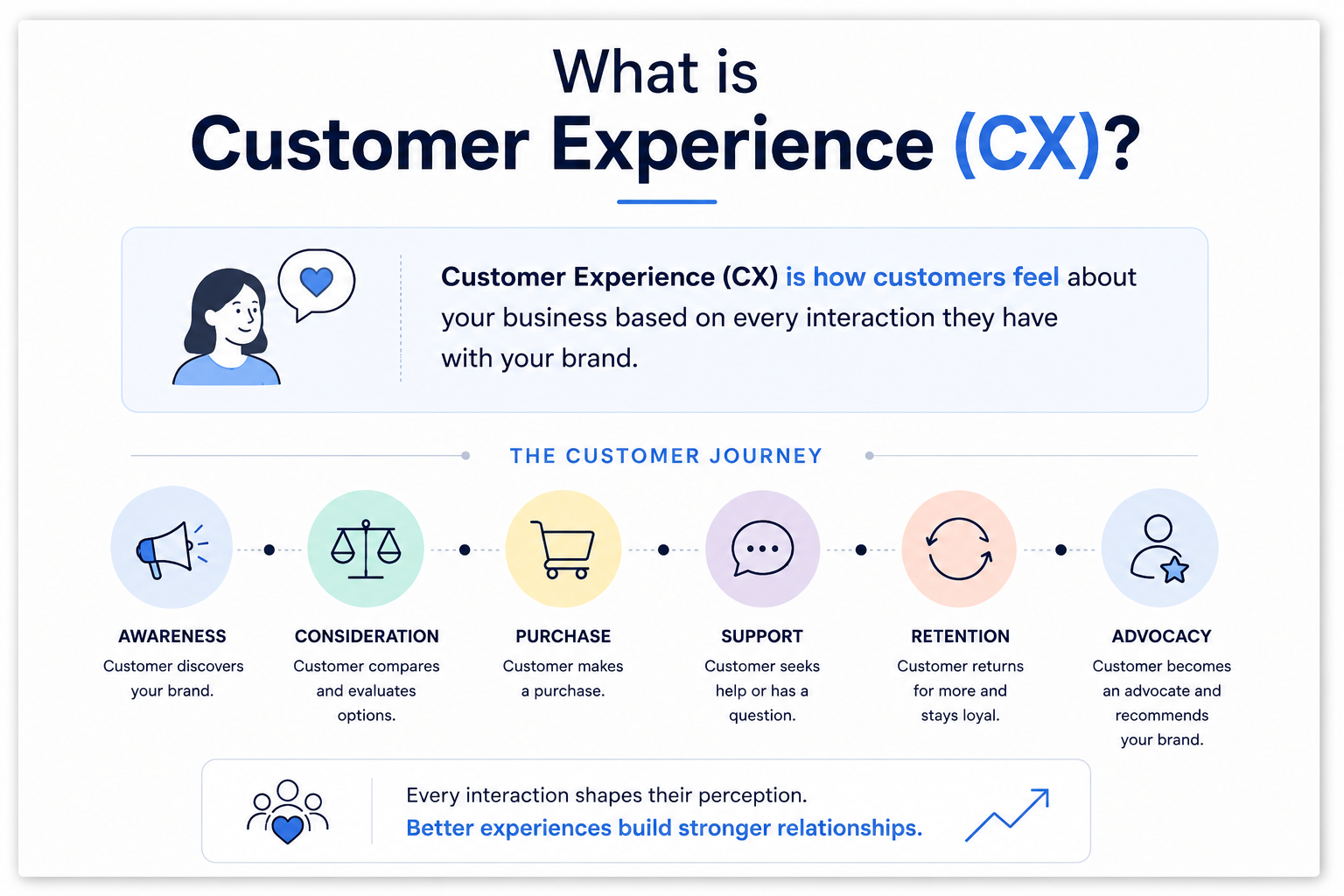
Customer Experience (CX) is the sum of every interaction a customer has with a brand throughout their journey, from awareness and purchase to support and retention. It reflects how customers perceive and feel about a business across all touchpoints.
Customer Experience is the impression customers carry with them after interacting with your business. It is shaped when customers discover your brand, compare options, make a purchase, contact support, or return for a second transaction.
No single interaction defines customer experience. Unlike businesses, customers don’t compartmentalize departments. They simply remember how easy, helpful, frustrating, or enjoyable it felt to do business with you.
Difference Between CX and Customer Service
Customer service refers to a specific interaction. It comes into play when a customer needs help, asks a question, reports a problem, or seeks guidance.
Customer experience is much broader. It includes customer service, but it also includes every other touchpoint that shapes perception. The ease of navigating a website, clarity of pricing, delivery speed, quality of communication, etc., and even how easy it is to cancel a subscription.
A simple way to think about it:
| Customer Service | Customer Experience (CX) |
| Focuses on a specific interaction | Covers the entire customer journey |
| Typically reactive to customer requests | Includes both proactive and reactive interactions |
| Usually handled by support teams | Influenced by every department |
| Measures issue resolution and service quality | Measures overall perception and loyalty |
| Begins when a customer needs help | Starts from the first brand interaction |
| Solves a problem | Shapes the entire relationship |
Why Customer Experience Matters in 2026
Customers are spoiled for choice. All it takes is a few clicks to switch brands. In this environment, customer experience determines who stays, who leaves, and who recommends a business. Customer experience management:
- Retains more customers by giving them reasons to stay that go beyond price or convenience. SAP reports that companies focused on stronger CX retain nearly 9 out of 10 customers!
- Intercepts churn before it happens. CX helps identify friction points and eliminate customer effort across the journey.
- Generates stronger revenue growth. This is brought on by repeat purchases, higher customer lifetime value, and increased loyalty. According to Forrester, a single-point increase in CX could potentially unlock $1 billion in additional revenue!
- Builds a stronger reputation. Common drivers include positive reviews, referrals, recommendations, and word-of-mouth advocacy.
- Drives operational efficiency. CX-focused businesses will notice fewer complaints, repeat contacts, and unnecessary escalations.
- Differentiates the business when products and pricing are easily replicable by the competition.
Key Components of Customer Experience
Customer experience extends far beyond customer support. After all, customers remember a collection of moments. They shape how people feel about a brand. A few components that influence this perception more:
1. Customer Support
Support is the linchpin of the customer experience. After all, customers typically reach out when they need help or reassurance. Fast responses, knowledgeable agents, and frictionless resolutions in such high-stakes moments build trust.
The opposite is true as well. Poor support, on the other hand, can undo an otherwise positive relationship in a matter of minutes.
2. Product Experience
Sometimes the product itself is the customer experience. Obviously, customers won’t have to reach out to salespersons or service agents if a product does its job. Products and services should reliably solve customer problems while minimizing effort and complexity.
No amount of marketing or support can fix it if the product fails something this basic.
3. Website and App Experience
Customers take to digital channels long before they speak to a sales representative or support agent. In fact, PwC found that 55% of consumers use search engines to collect pre-purchase information. So, every digital interaction matters.
Clear interfaces, intuitive design, and seamless transactions allow customers to steer confidently. In contrast, slow load times, broken journeys, and complex navigation turn people away.
4. Communication and Engagement
Every email, notification, reminder, and update leaves its mark. Customers want to stay informed. But they also don’t want to be bombarded. A shipping update arriving at the right moment feels helpful.
Five promotional emails in two days feel exhausting. The brands that communicate well know the difference. They reach out with purpose to make every interaction count.
5. Personalization
Customers expect businesses to remember who they are. Not in a creepy way. In a practical one. Someone shouldn’t keep seeing ads for a product they’ve purchased. They shouldn’t have to repeat the same information if they’ve contacted support before.
SAP found that six out of ten consumers value highly personalized content for exactly this reason. Done right, personalization removes friction. Interactions naturally feel more intentional and thoughtful.
6. Omnichannel Interactions
According to McKinsey, customers engage with 3 to 6 channels on average during a standard B2C purchase journey. They move between them, but they rarely consider them distinct. Customers view these interactions as part of one continuous experience rather than separate channels. A strong omnichannel customer experience connects every interaction.
The Customer Journey and CX
The customer journey is the path customers follow as they interact with a business. It begins the moment they become aware of a brand. Then, it flows through evaluation, purchase, onboarding, support, retention, and, ideally, advocacy.
Customer experience is the cumulative outcome of every interaction across the customer journey. Every stage presents opportunities to build trust or create frustration. This is why CX leaders focus on understanding customer journeys in detail. Here’s an overview of the interplay between them:
| Customer Journey Stage | What Happens at This Stage | Common CX Pain Points |
| Awareness | A potential customer comes across the brand for the first time. They begin forming initial impressions. | Unclear messaging Inconsistent brand positioning Hard to locate information |
| Consideration | The customer explores options, weighs alternatives, and decides whether the offering is worth pursuing. | Poor product information Lack of reviews or social proof Confusing pricing |
| Purchase | Interest turns into action. The customer moves forward and completes a transaction. | Lengthy checkout process Hidden fees Payment failures |
| Onboarding | The customer starts using the product or service and looks for early signs that they made the right choice. | Complex setup steps Insufficient guidance Delayed activation |
| Support | Questions, concerns, or issues arise, calling for assistance, clarification, or resolution. | Long wait times Repeating information Inconsistent resolutions |
| Retention | As the relationship matures, the customer evaluates whether the ongoing experience justifies staying engaged. | Generic communication Lack of proactive engagement Unresolved recurring issues |
| Advocacy | Customers recommend, review, or champion the brand after positive experiences. | Difficult referral processes Limited feedback channels Lack of recognition for loyal customers |
How AI is Transforming Customer Experience in 2026
There’s no going back once people get used to faster service, personalized recommendations, or instant answers. Businesses are using AI in customer experience to keep the momentum going. It comes into focus as:
1. AI Chatbots and Virtual Assistants
Support teams face a difficult balancing act. On the one hand, conversation volumes keep rising. On the other hand, customers still expect quick answers. AI chatbots help absorb routine queries, surface information faster, and maintain context across interactions.
This alleviates queue pressure. It also frees up agents to focus on complex issues. They can field queries that require investigation, judgment, or empathy.
2. Hyper-Personalized Customer Interactions
Most businesses collect customer data. Far fewer use it effectively. Customers notice when every message looks the same, regardless of their history, preferences, or previous interactions.
AI in customer experience helps connect these scattered signals and turn them into more relevant communication. Instead of broadcasting the same message to everyone, businesses can respond with greater context and precision.
3. Predictive Customer Support
Traditional support begins after a customer encounters a problem. By then, frustration has already entered the conversation. AI in customer experience detects unusual patterns, service disruptions, and emerging issues earlier in the process.
That visibility allows teams to nip the problem in the bud. They intervene before isolated incidents blow up. It’s a win-win situation for everyone involved. Customers get a smoother experience, whereas support teams face lighter workloads.
4. Voice AI and Conversational Intelligence
Voice support has always struggled with one problem: effort. Customers often navigate multiple menus, repeat information, and wait to reach the right destination.
Modern voice AI reduces that friction by understanding intent and maintaining context throughout the interaction. Conversations become more direct and less procedural, helping customers reach a resolution with fewer steps.
5. Customer Experience Automation
Many customer frustrations have nothing to do with the actual interaction. They stem from what happens behind the scenes. A missed update, a delayed approval, or a breakdown between teams creates friction long before a customer contacts support.
Customer experience automation keeps these processes moving. It circumvents manual handoffs and unifies information. As a result, customers experience fewer delays and fewer surprises.
6. AI-Powered Journey Insights and Decision Making
Every customer journey generates signals about what is working and what is not. The challenge lies in identifying meaningful patterns from the enormous volume of customer data generated across channels.
AI-enabled customer journey analytics highlights recurring friction points, drop-off trends, and areas where customers struggle. These insights give teams a clearer view of the experience they are actually delivering. Knowing the problem areas makes it easier to run targeted improvement efforts.
Top CX Trends for 2026
Businesses are under pressure to deliver richer experiences. What impressed customers a few years ago barely earns a second glance today. Customer experience trends show where we’re headed.
Hyper-Personalization
Broad customer segments are becoming less useful. People expect experiences that reflect their preferences, behavior, and history. A recommendation that feels relevant stands out, while a generic one gets ignored. Customers increasingly compare brands against the best experience they have had, regardless of the industry.
AI-Powered Self-Service
Customers hate waiting. They would rather find an answer themselves. That preference is pushing self-service far beyond basic FAQs. AI-powered tools can now handle a much wider range of requests, helping customers find resolutions faster without adding pressure on support teams.
Proactive Customer Support
Waiting for complaints is becoming an expensive way to run service operations. More businesses are identifying issues earlier and communicating before frustration builds. The focus is shifting from resolving problems after they occur to preventing them altogether.
Emotion AI and Sentiment Analysis
Understanding what customers say is one thing. Understanding how they feel provides a much deeper layer of customer insight. Sentiment signals help teams identify urgency, frustration, and satisfaction levels. This application of AI in customer experience allows businesses to prioritize critical conversations and respond more effectively.
Unified Omnichannel Experiences
Customers move between channels without giving it much thought. The responsibility lies with businesses to maintain context across every interaction. A strong omnichannel customer experience ensures that conversations remain connected, regardless of where they begin or continue.
Customer Experience Automation
Automation is expanding far beyond customer support. Businesses now use customer service automation across onboarding, renewals, account management, feedback collection, and customer communications. The goal is simple: remove friction, improve efficiency, and deliver more consistent experiences at scale.
Real-Time Customer Journey Analytics
Most organizations collect vast amounts of customer data but struggle to turn it into action. Real-time customer journey analytics helps identify friction points, churn risks, and breaks in customer journeys as they happen. These insights make it easier for teams to improve experiences before small issues become major problems.
Customer Experience Metrics and KPIs
Improvement should be measurable. Leading organizations combine customer feedback with hard performance data to chart their journey. This is where CX metrics become valuable. They help teams track where the customer experience strategy is heading:
| Metric | What It Tells You | Formula | Why Track It |
| NPS | Are customers willing to recommend you? | % Promoters – % Detractors | Loyalty usually shows up here first. |
| CSAT | How customers felt about a specific interaction | (Satisfied Responses ÷ Total Responses) × 100 | Highlights service strengths and weak spots. |
| CES | How hard customers had to work to get something done | Survey-based rating | Friction tends to drive churn. |
| Customer Retention Rate | How many customers stay over time | (Customers at End – New Customers) ÷ Customers at Start) × 100 | Retention often reflects the overall CX. |
| First Response Time (FRT) | How quickly customers receive an initial response | Total First Response Time ÷ Total Number of Inquiries | Slow responses create frustration quickly. |
Best Customer Experience Examples
Customers don’t describe an experience as “great CX.” They describe what happened. Their order arrived exactly when expected. Support solved a problem without making them repeat themselves. The app remembered where they left off.
Great customer experience usually shows up in these small moments. Here’s how they manifest in different industries:
1. Customer Experience Examples: Ecommerce
A customer discovers a product through social media. They click on it and land on the website offering relevant recommendations. Product information is clear. Reviews are easy to find. Checkout takes seconds rather than minutes.
After purchase, the experience continues. Order confirmations arrive instantly. Delivery updates are proactive. The customer receives an update proactively if a shipment is delayed. A conversational AI chatbot provides answers immediately, should they need support. A live agent is available on standby for escalations. Every interaction reduces effort and reinforces confidence in the brand.
2. Customer Experience Examples: SaaS
A customer signs up for a software platform. They want to solve a specific problem and not explore a feature catalog. They receive a tailored onboarding journey that matches their goals. The platform highlights the most relevant workflows and guides them toward their first success quickly.
The support experience remains just as contextual. Product tutorials appear when needed. Help articles surface automatically based on user activity. The support team already knows their subscription plan, product usage, and previous interactions. As a result, the customer spends less time explaining their situation while raising a ticket.
3. Customer Experience Examples: Banking
A customer notices an unfamiliar transaction while checking their account. They open the banking app and report the issue directly from the transaction screen. The process takes a few taps. No need to call customer support.
A confirmation appears immediately, along with a reference number and expected timelines. Status updates arrive automatically as the case moves forward. If escalation becomes necessary, the agent already has access to the transaction details and previous interactions. The customer picks up where they left off instead of starting over.
4. Customer Experience Examples: Hospitality
A guest books a hotel room online after comparing multiple options. The booking process is simple, pricing is transparent, and confirmation arrives instantly. Before check-in, the hotel sends useful information about directions, amenities, and local recommendations.
The experience continues after arrival. Guests can check in quickly, access support through their preferred channel, and receive personalized recommendations based on their stay preferences. If they request room service, housekeeping, or assistance, the staff already has the necessary context to respond efficiently.
Even after checkout, the relationship doesn’t end. Guests receive relevant follow-up communication, loyalty rewards, and personalized offers for future stays. Every interaction feels connected, making the guest feel valued rather than treated like just another reservation.
In hospitality, great customer experience comes from anticipating guest needs, reducing effort, and delivering consistent service across every touchpoint of the journey.
Customer Experience Tools and Platforms
Great CX is the result of multiple customer experience solutions working together. After all, the network is distributed. Customer data lives in one place, support conversations happen in another, and customer feedback flows through various channels. The orchestration of these customer experience tools creates a good customer experience.
1. CRM Systems
Customer relationships generate a steady stream of information. Every customer interaction leaves behind information. This could be a purchase, a support conversation, or a service request. CRM systems bring these details into one place.
The customer data is easier to access and use for sales, support, and customer success teams. The unified view of the customer history replaces separate records.
2. AI Chatbot Platforms
Support requests do not follow a schedule. Customers ask questions during business hours, late at night, and everything in between. AI chatbot platforms help handle routine conversations, answer common questions, and direct more complicated issues to the right team.
This allows support agents to spend less time on repetitive queries and more time on cases that need deeper investigation.
3. Helpdesk Software
As customer conversations increase, keeping track of requests becomes difficult without structure. Helpdesk software provides that structure. It centralizes support interactions, routes requests to the right teams, and helps businesses monitor response and resolution performance.
This visibility plays an important role in maintaining service quality as support volumes grow.
4. Customer Feedback Tools
Customer feedback often arrives from multiple directions. Some customers complete surveys. Others leave reviews, ratings, or direct comments. Feedback tools bring these inputs together instead of leaving them scattered across channels.
Patterns become easier to spot. Teams can see which issues customers mention repeatedly and which areas of the experience deserve closer attention.
5. Analytics and Journey Mapping Tools
Customer journeys are non-linear and non-uniform. Some compare options for weeks. Others go on and off several times before making a decision. Customer journey analytics and mapping tools help identify patterns for every customer.
They highlight where customers drop off, where friction appears, and which parts of the journey need attention.
Future of Customer Experience
Customers view their experience as the sum of every interaction they have with a brand. And so, every interaction at every stage of the journey matters. There’s no room for long wait times, repeated questions, and disconnected experiences. After all, there are better alternatives available.
That said, the entire customer journey needs to be visible to meet these expectations. Teams need customer experience solutions to access the right information at the right time. Businesses evaluating customer experience platforms should look for solutions that unify customer data, support operations, automation, and analytics. Kapture CX is one such customer experience platform designed to help teams deliver consistent experiences at scale.
Kapture CX helps businesses bring customer conversations, support operations, automation, and insights together in one place. The result is a clearer view of the customer journey and a stronger foundation for delivering consistent experiences at scale.
Book a demo with Kapture CX to see how leading support teams improve customer experience.
FAQs
Customer Experience (CX) refers to the overall perception customers form about a business based on every interaction they have throughout their journey. These interactions can include marketing communications, website visits, purchases, customer support conversations, and post-purchase engagement.
Customer experience influences whether customers stay, leave, or recommend a business to others. A positive experience can encourage loyalty and repeat business. A poor CX can quickly damage trust.
AI helps businesses improve customer experience by enabling faster support, personalized interactions, predictive issue resolution, intelligent self-service, and customer experience automation. It allows organizations to deliver consistent and efficient experiences across multiple channels.
Some of the most widely used CX metrics include Net Promoter Score (NPS), Customer Satisfaction Score (CSAT), Customer Effort Score (CES), Customer Retention Rate, and First Response Time (FRT). Together, these metrics help businesses measure customer satisfaction, loyalty, and service performance.
Businesses typically use a combination of customer experience solutions such as CRM systems, helpdesk software, AI chatbot platforms, customer feedback tools, and customer journey analytics platforms. These tools help organizations understand customer behavior, streamline support operations, and improve experiences across the customer journey.



 +1833-386-0222 (USA)
 enquiries@kapture.cx