













TL;DR
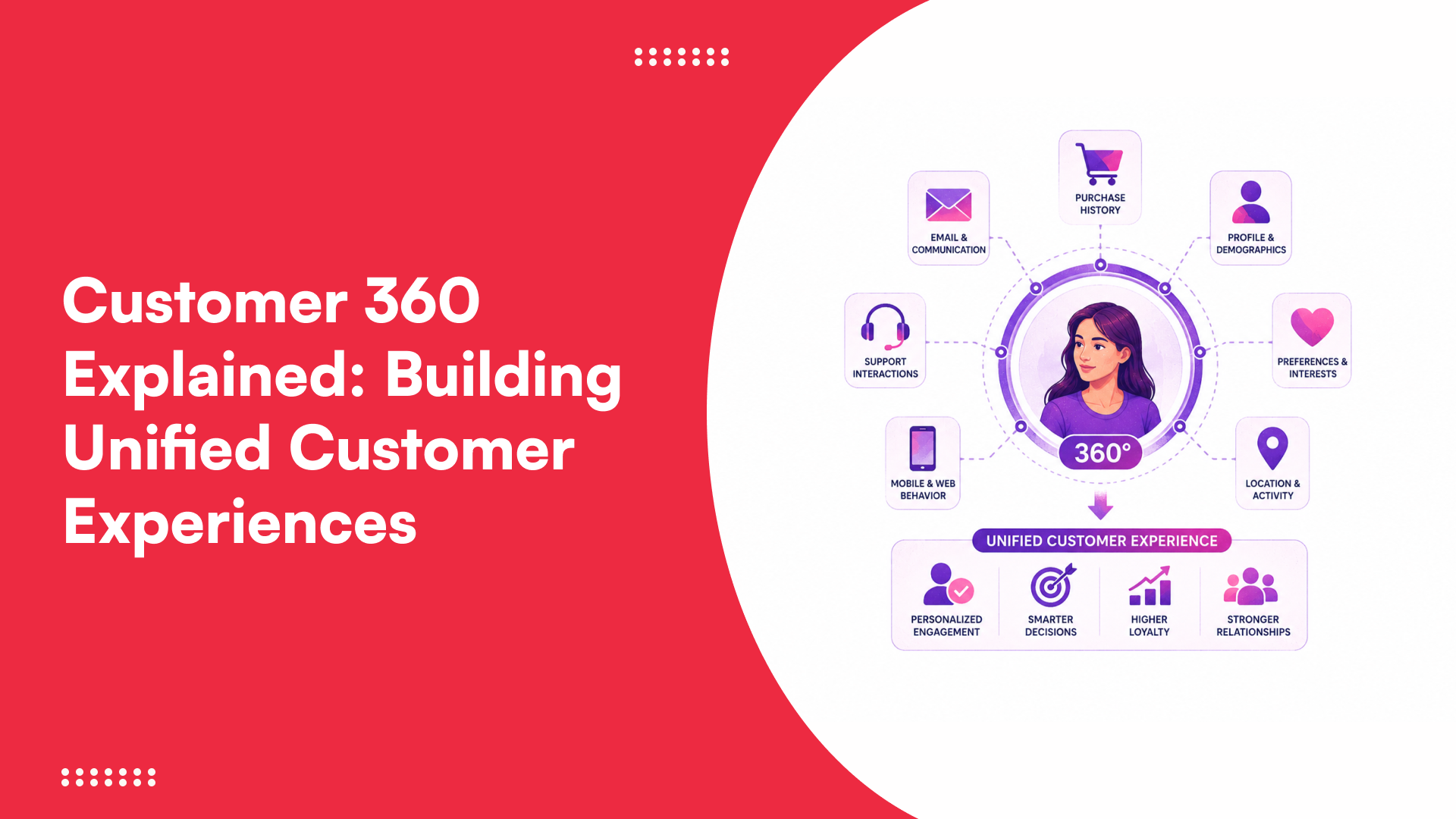
Customer 360 helps businesses bring all customer data into one place. Instead of working with disconnected information across sales, marketing, and support systems, teams get a complete view of every customer. This makes it easier to deliver personalized experiences, improve customer service, and make smarter business decisions.
Customer data used to exist in silos. One system contained a purchase record, while another contained support tickets. Meanwhile, the marketing team continues sending promotional emails for products that the customer has already returned.
This fragmented setup worked when customer expectations were simpler. However, consumers in 2026 anticipate that brands will be able to instantaneously identify them while recalling previous exchanges and react contextually on all platforms.
That shift has made Customer 360 essential. It is bringing together scattered data into a unified customer view, and so businesses can finally understand customers as a whole rather than as isolated interactions. This foundation is what powers more consistent experiences and stronger customer relationships today.
Here, in this guide we’ll explore what customer 360 is and look into depth on how it actually works for businesses.
What is Customer 360?
Customer 360 is a data integration approach. It creates one unified customer view across all business systems. It consolidates customer data from multiple sources into one profile.
These sources include CRM systems, customer support platforms, marketing tools, e-commerce platforms, billing systems, etc. The goal is to unify customer data across the enterprise.
A Customer 360 platform connects these systems. It continuously collects and updates customer records so that every team works with the same data.
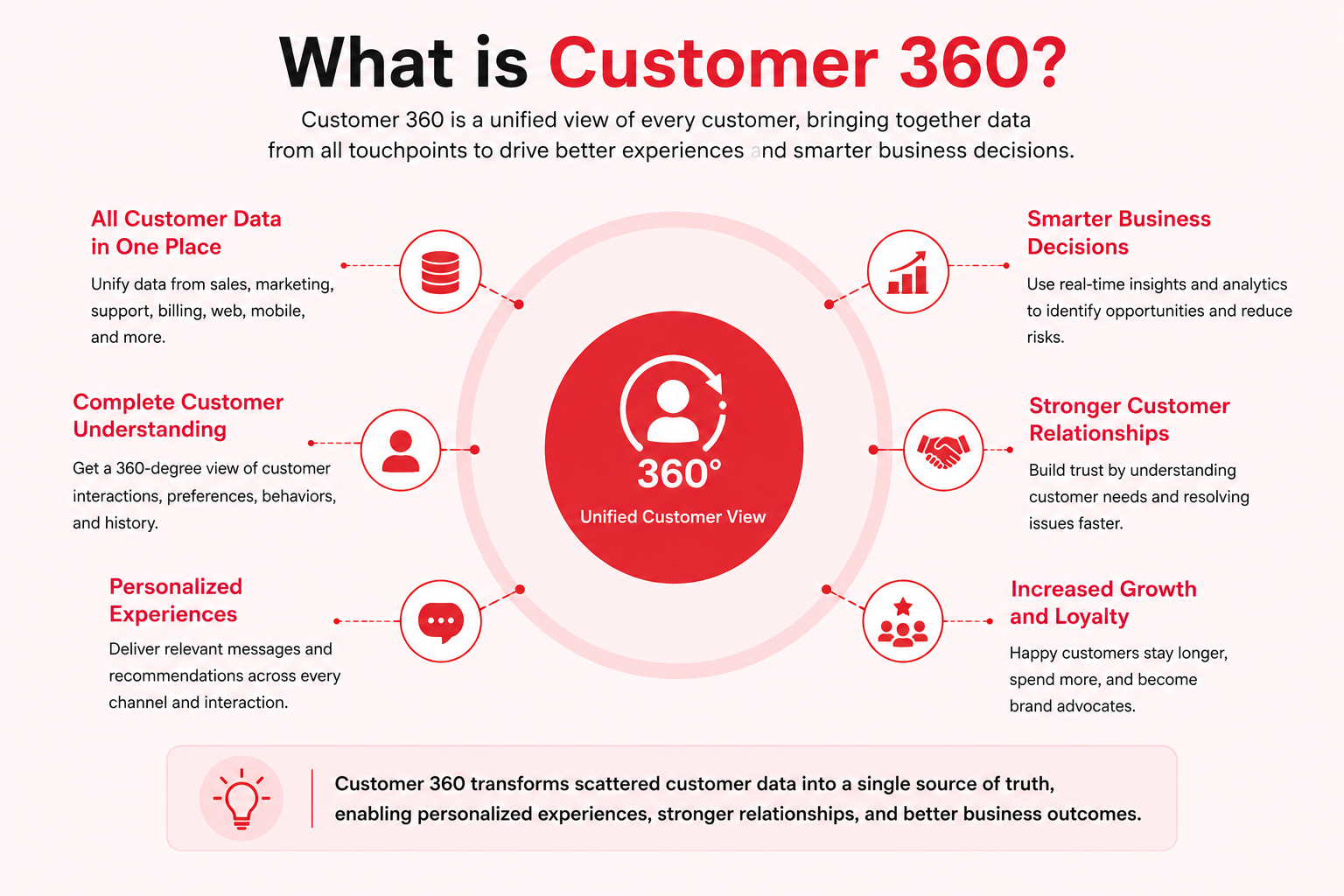
Most of the time, a customer data platform is used as the foundation. It stores unified customer profiles in real time or near real time. A customer insights platform may sit on top to analyze behavior patterns.
Key components of Customer 360 systems are as follows:
- Data ingestion layer
- Identity resolution engine
- Data unification layer
- Activation layer
- Analytics layer
Customer 360 for enterprises improves data consistency. It reduces duplication and conflicts in customer records.
Why Customer 360 Matters for Businesses?
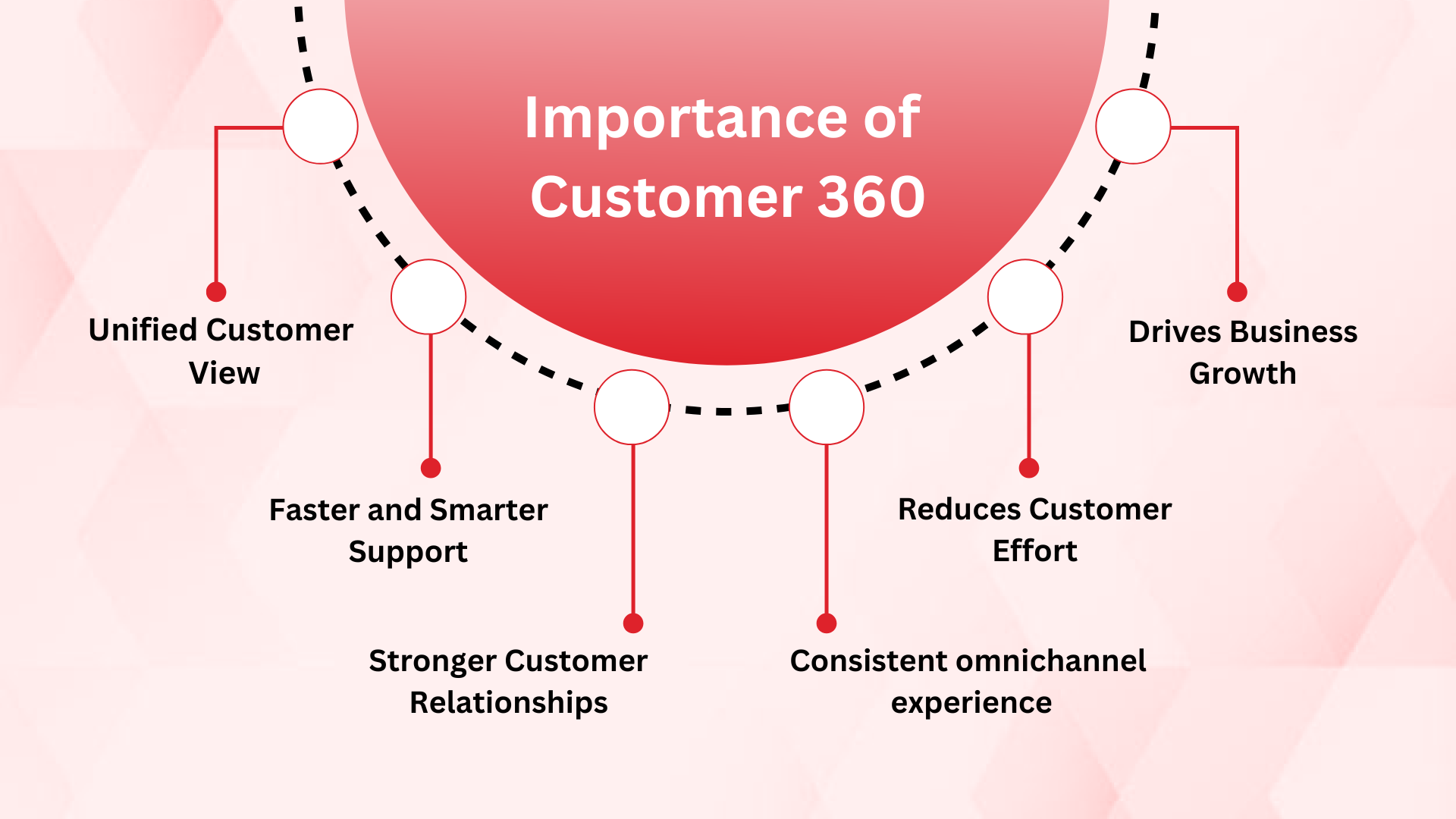
Customer 360 matters because businesses can no longer afford disconnected customer data.
Most organizations already collect huge amounts of information, but it’s spread across tools and departments. Marketing sees engagement data, sales tracks pipeline activity, support handles tickets, and product teams analyze usage separately. Teams react slowly and inconsistently because there is no unified view.
Customer 360 changes that by giving everyone access to the same customer intelligence in real time.
- Marketing Team: Leads to smarter targeting. They no longer rely only on demographics; campaigns can adapt based on behavior, intent, engagement patterns, etc.
- Sales Team: Reps can see product usage, support history, and buying signals before reaching out, making conversations more relevant and improving conversion chances.
- Support Team: Agents can quickly understand a customer’s history, recent issues, and overall account value without jumping between systems.
This unified view also strengthens conversational AI in customer support, allowing virtual assistants to provide faster and more context-aware responses.
There’s also a major operational benefit.
Businesses have to cope with inconsistent reports and duplicate records when systems are disconnected. Customer 360 helps teams stay in sync and make decisions more quickly by establishing a common information source.
More significantly, it causes companies to transition from reactive to proactive operations.
Teams are able to identify warning signals of churn before consumers depart. AI can automatically discover high-potential accounts and eliminate the need to manually seek out upsell chances.
How Customer 360 Works?
Customer data is continuously gathered, combined, and analyzed by a Customer 360 system, which functions as a tiered data architecture. Here is how it works:
1. Gathering Client Information Through Various Channels
Ingesting data from multiple interaction points is part of the first layer. Websites, mobile apps, emails, social media, CRM systems, and support platforms are all used by modern firms to gather consumer data. Additionally, several businesses combine offline transaction systems with IoT.
Both batch processing and real-time streaming pipelines are used by a Customer 360 platform. ETL (Extract, Transform, Load) processes, event trackers, and APIs are used to feed raw data into a centralized system. This is managed by a Customer Data Platform, which is the basic intake layer.
2. Establishing Integrated Client Profiles
Customer data unification is the next stage after data collection. Through this process, disparate records are combined into a single identity. Users are matched across channels and devices using identity resolution mechanisms. These include probabilistic matching (behavioral patterns, device signals) and deterministic matching (phone number, email).
A unified customer view, sometimes known as a “golden record,” is then created by the system. It is the responsibility of the Golden Record to make sure that each interaction is linked to a single, consistent profile
To guarantee accuracy across constantly changing datasets, a robust Customer 360 solution also uses data standardization and deduplication.
3. Using Analytics and AI to Gain Customer Understanding
Data can be used for prediction and intelligence once it has been unified. Engagement signals and behavioral patterns are examined by machine learning algorithms. A consumer insights platform uses next-best-action modeling and AI-driven segmentation to make proactive engagement tactics and real-time personalization possible.
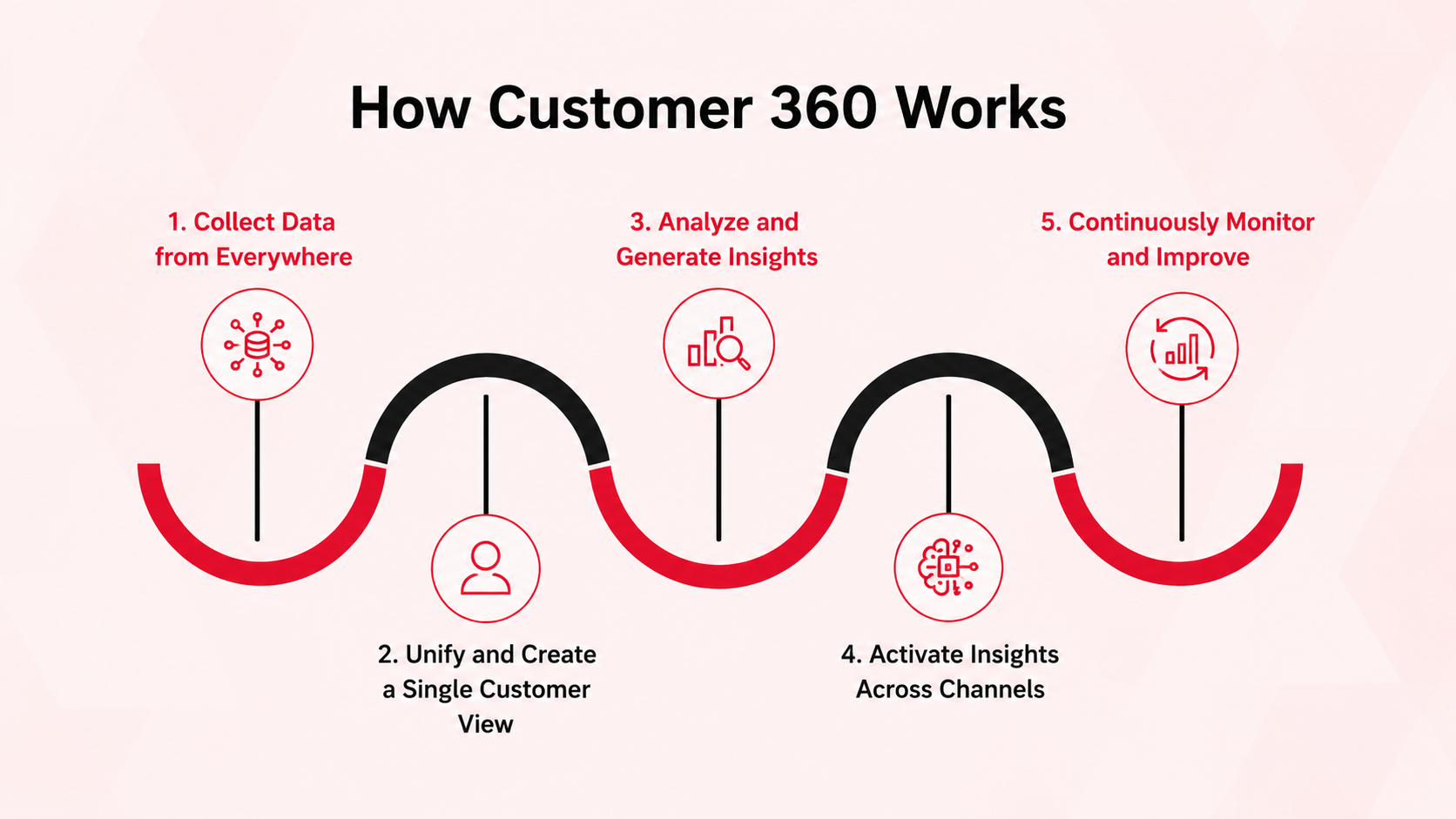
In advanced setups, Customer 360 for customer experience helps teams respond to customer needs instantly across channels.
When combined, these layers turn unprocessed data into a dynamic intelligence system that drives contemporary customer experience tactics.
Top Benefits of Customer 360
A Customer 360 approach delivers measurable business impact because it removes data fragmentation and replaces it with a unified customer view. Let us look at some of the top benefits of a Customer 360 platform.
1. Stronger Revenue Growth Through Personalization
When customer data is unified, personalization becomes significantly more precise. According to McKinsey research, effective personalization can drive a10–15% revenue uplift, and companies that excel at it generate up to 40% more revenue from personalization than average performers.
A customer data platform powered by a Customer 360 setup ascertains that every interaction is context-aware. This directly improves cross-sell and upsell accuracy, as recommendations are based on full behavioral history.
2. Faster Decision-making in all Teams
One of the most immediate benefits of a Customer 360 platform is speed. A unified dataset eliminates the need to reconcile conflicting reports from different systems. Teams operate from a single source of truth.
Research from AWS and APQC shows that organizations using Customer 360 achieved a 43.9% reduction in sales cycle duration and a 25.3% faster time to market. This only means one thing, and it is that insights move from data to action quickly when customer data unification is in place.
3. Better Retention and Lesser Churn
A Customer 360 solution improves churn prediction by connecting behavioral signals across channels. Systems can detect early warning indicators such as declining engagement or negative support interactions.
Proactive retention workflows are then implemented to improve customer lifetime value and reduce acquisition dependency.
4. Higher Operational Efficiency
In the absence of a unified system, teams constantly deal with inconsistent metrics. They also have to do manual data reconciliation. Customer 360 for enterprises eliminates this overhead by standardizing identity resolution and data governance.
A customer insights platform built on unified data reduces reporting discrepancies and ensures every department works with aligned metrics.
Customer 360 Use Cases Across Industries
When used in actual operating settings, a customer 360 approach is most beneficial. It assists businesses in bringing disparate data together and providing uniform consumer experiences across all touchpoints.
AI-powered customer experience platforms combine multichannel interactions, automation, and unified customer context, thereby reducing the load on customer support heavy organizations. As a result, support workers can keep a thorough record of every client encounter while resolving problems more quickly.
1. E-commerce Industry
Retailers use Customer 360 to connect customer interactions across websites, apps, stores, and support channels. By bringing all customer data into one place, businesses gain a complete view of every shopper. This helps them deliver personalized recommendations, improve marketing campaigns, reduce cart abandonment, and build stronger customer relationships.
By finding obstacles in the consumer path, it also aids in lowering cart abandonment.
2. Financial Services and Banking
Banks use Customer 360 to bring customer data into a single view. This helps teams detect fraud faster, assess risk more accurately, and recommend the right financial products. When compliance teams and relationship managers work with the same verified customer information, they reduce data inconsistencies, make better decisions, and build stronger customer trust.
3. SaaS Industry
Customer 360 is essential for comprehending how customers engage with a product over time in the SaaS and IT industries. A Customer 360 platform unifies in-app activity, support conversations, subscription information, and product usage data into one view.
SaaS organizations may create lifecycle models that are more accurate. This enables them to create onboarding processes that change according to actual usage patterns and not predetermined schedules.
How to Implement a Customer 360 Strategy?
Building a Customer 360 strategy starts with understanding where your customer data lives. Most businesses store customer information across multiple systems, including CRM platforms, marketing tools, support software, billing systems, and product analytics solutions.
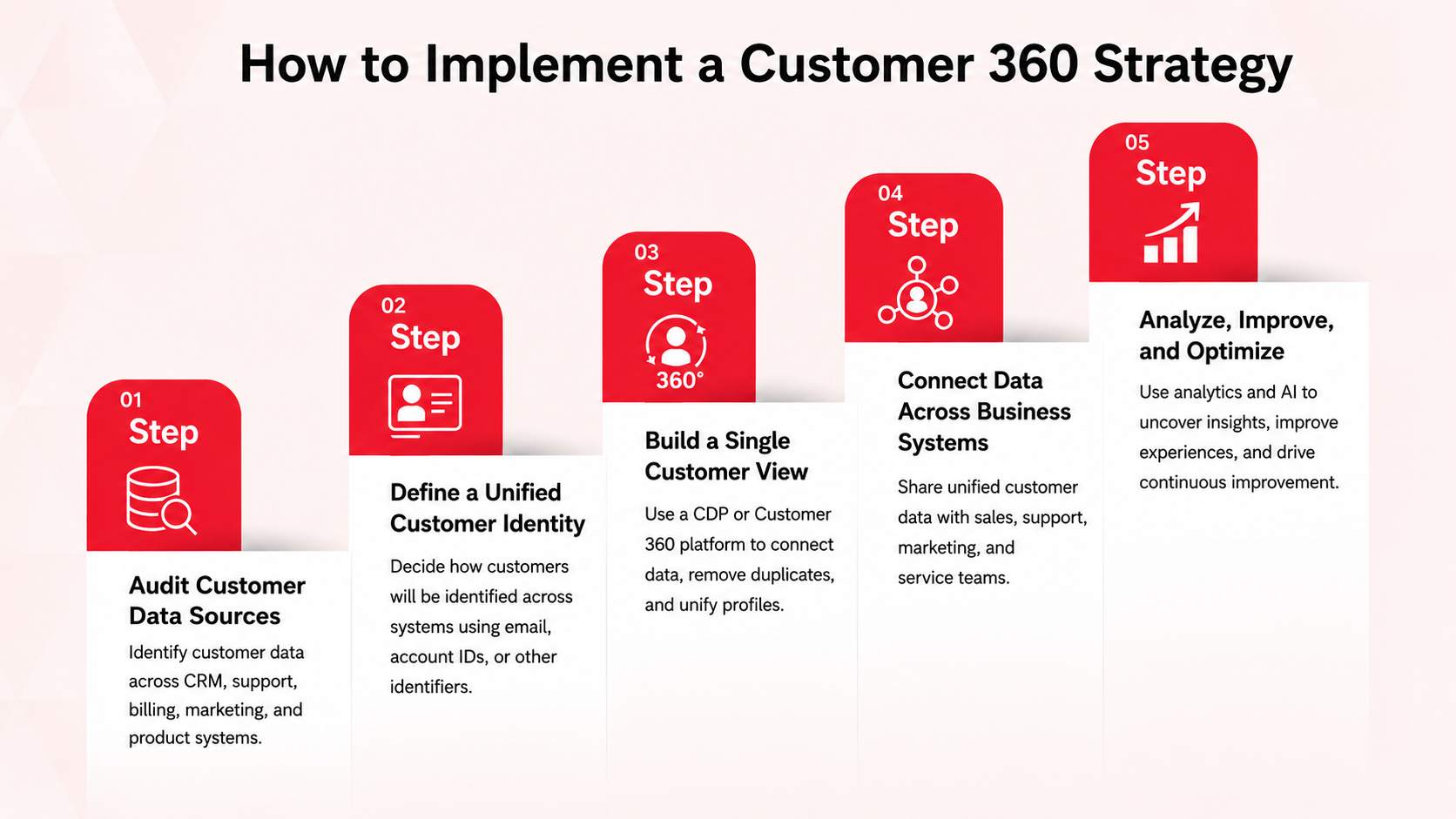
The first step is bringing visibility to all these data sources.
Next, decide how you want to identify a customer across your organization. Some businesses use email addresses, while others rely on account IDs, phone numbers, or a combination of identifiers. Having a common identifier makes it easier to connect customer information from different systems.
Once this foundation is in place, introduce a Customer Data Platform (CDP) or Customer 360 solution to bring everything together. The platform collects customer information, removes duplicate records, and creates a unified customer profile.
With a single customer view in place, teams across sales, marketing, and customer support can access the same information. This eliminates data silos and helps deliver more consistent customer experiences.
The final step is turning data into action. By applying analytics and AI, businesses can uncover customer behavior patterns, personalize interactions, and make better decisions. Over time, Customer 360 evolves from a data project into a system that continuously improves customer experiences and business performance.
Future of Customer 360
Static customer profiles are giving way to real-time intelligence in the future of Customer 360. Businesses are moving towards records that are updated on a regular basis and systems that continuously learn from every contact across channels. The need for context-aware decision-making and the explosive growth of customer data are behind this shift.
The boom of AI-driven customer systems is one significant trend. The use of machine learning algorithms to identify churn early and suggest the best course of action without human intervention is growing. Concurrently, Customer Data Platforms are developing into composable architectures, in which companies link modular data services.
Another change is taking place in the areas of governance and privacy. Stricter consent management, data minimization, and compliance controls are being incorporated into the architecture of future-ready Customer 360 systems rather than being added afterwards.
The emphasis is shifting from data collection to real-time activation as these systems develop. Companies are beginning to place a higher priority on the speed at which insights can be used all over.
Kapture CX is combining customer context and support intelligence into a single environment to support this change. Book a personalized demo to see how unified customer experiences can work in real life.
FAQs
Customer 360 is a unified view of customer data collected from multiple business systems. It helps organizations connect customer interactions, purchase history, support conversations, and behavioral data in one place, enabling personalized experiences, better customer service, and smarter business decisions.
No, even mid-sized businesses can benefit from Customer 360 by improving data visibility and reducing fragmented customer records.
A CRM focuses mainly on sales interactions, while Customer 360 combines data from multiple systems to create a complete customer profile.
Not always, but real-time data significantly improves accuracy and helps businesses respond to customer behavior faster.
Yes, but AI improves the customer 360 value by enabling predictions, segmentation, and automated decision-making at scale.
The most common challenge is dealing with inconsistent and scattered customer data across different systems. Even when data exists, it often doesn’t match cleanly, which makes building a reliable unified profile difficult.
Customer 360 gives all departments access to the same customer information, reducing misalignment and improving decision consistency.




 +1833-386-0222 (USA)
 enquiries@kapture.cx