













TL;DR
- Kapture CX is best for enterprise level customer experience automation, AI-powered ticketing, and omnichannel support.
- Kore.ai and Moveworks are ideal for enterprise-wide AI workflows across customer service, IT, and HR.
- Cognigy and Retell AI specialize in voice AI and conversational automation.
- Rasa, Yellow.ai, Intercom Fin AI, and Ada offer different strengths in customization, customer service automation, and AI-powered support.
Enterprise conversational AI is becoming a core part of modern customer experience strategies. According to recent research, 85% of customer service leaders plan to explore or test conversational AI technologies for customer interactions.
As adoption grows, many organizations are reevaluating the tools they use. Although Sierra AI is known for its AI-powered customer support capabilities, businesses often evaluate alternatives based on factors such as flexibility, integrations, pricing, and customization.
As a result, interest in Sierra AI alternatives continues to grow. Modern conversational AI platforms do much more than automate responses. They can understand context, automate workflows, integrate with business systems, and deliver better customer experiences at scale.
In this guide, we compare the best Sierra AI alternatives in 2026 to help you find the right platform for your business.
What Makes a Great Sierra AI Alternative?
As conversational AI becomes more integrated into customer experience operations, businesses are looking beyond surface-level benefits and asking a more important question: Can this platform genuinely scale with us?
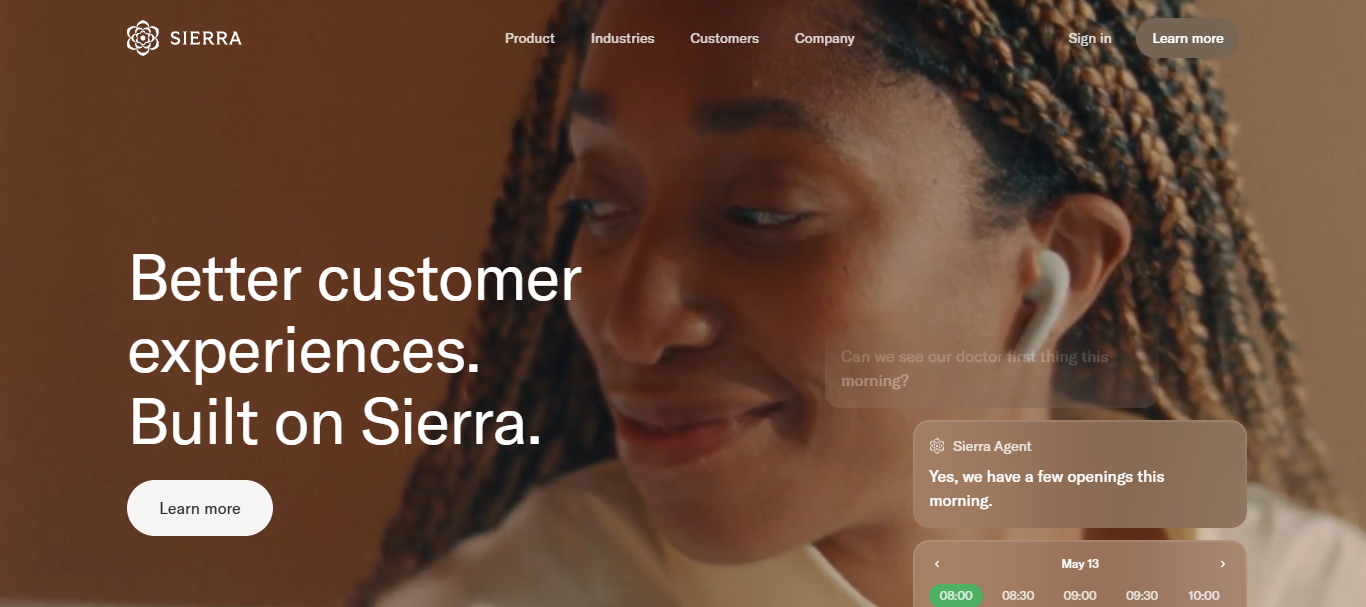
As businesses evaluate competitors to Sierra AI, this question has become particularly relevant. While Sierra AI has received praise for its brand-focused experiences and enterprise-grade AI agents, several reviews and industry assessments highlight ongoing concerns around pricing transparency and integration requirements. Some businesses have also reported longer implementation timelines and limited control over workflows without vendor assistance.
As a result, the conversation is no longer limited to choosing an AI chatbot. Today’s businesses need platforms that offer greater flexibility, control, and ownership.
Here are some of the key areas where the best Sierra AI alternatives stand out:
- More Advanced Conversational Intelligence: Modern platforms need to handle multi-step conversations without losing context or generating generic responses. This is especially important for customer service and account management workflows.
- Improved Automation Capabilities: Instead of simply responding to inquiries, businesses expect AI agents to initiate workflows and connect with business systems.
- Flexible Integrations: Fragmented data remains a common challenge in enterprise AI deployments. Platforms that integrate with CRMs, support systems, analytics tools, and enterprise databases deliver greater long-term value.
- Customization and Control: Rather than relying heavily on vendor-managed setups, many businesses prefer the ability to modify workflows, prompts, and business logic internally.
- Global Readiness and Multilingual Support: As customer bases become increasingly global, AI platforms must support localized conversations across multiple languages and communication channels.
- Analytics and Enterprise Visibility: Beyond automation rates, decision-makers need deeper insights into customer behavior, ROI, operational performance, and resolution quality.
9 Top Alternatives To Sierra AI
Here are the top Sierra AI alternatives, along with a detailed breakdown of their features, pros, cons, and best-fit use cases.
1. Kapture CX
Kapture CX is a strong alternative to Sierra AI for enterprises that want easier implementation and in-house migration support. Beyond that, for enterprises looking for advanced AI capabilities, Kapture offers its own agentic operating system, Kapture AgentOS, built across four layers.
4 Layers That Differentiate Kapture from Other Sierra Alternatives:
- Vitos: The AI agent platform that builds and runs AI agents for specific purposes: chatbot, conversational AI, voicebot, and more.
- Command: The human layer, where people approve, override, or step in on AI agent actions that need judgment.
- Calibrate: The audit layer, recording and assessing every AI and human action for compliance and quality.
- Pulse: The intelligence layer, analyzing patterns and feeding recommendations back into the system.
Here’s what that looks like in practice: a customer messages support asking to track an order. Vitos handles it end to end through conversational intelligence, pulling the order status and replying instantly, no ticket opened. If that same customer instead messages about a failed refund or a billing dispute, Vitos recognizes the conversation has moved outside a routine pattern and Command routes it directly to a human agent, with the full conversation history and account context already attached, so the customer never has to repeat themselves. Calibrate logs both interactions for audit either way. That’s the core difference from a single-purpose chatbot: the same conversational layer knows when to resolve and when to hand off, without the customer noticing a seam.
Kapture reports a 98% AI resolution rate and 2x faster operations across its deployments, driven by this routine-versus-judgment split rather than trying to automate everything indiscriminately.
Kapture is an enterprise customer experience platform that combines conversational AI, AI-powered ticketing, workflow automation, and omnichannel support into one system operated by AgentOS.
Key Features
- Omnichannel support across all customer communication channels
- AI-driven ticket routing, tagging, and resolution assistance
- Agent assist tools for summarization and suggested responses
- Enterprise integrations with CRM and backend systems
Pros
- End-to-end CX automation that goes beyond chatbot-level functionality
- Strong omnichannel coverage built for large-scale support operations
- Vitos lets enterprises build purpose-specific AI agents (chatbot, voicebot, conversational AI) rather than relying on a single fixed agent type
- Command keeps human judgment in the loop on actions that need it, with Calibrate providing a full audit trail
- Reports a 98% AI resolution rate across deployments
Cons
- Pricing isn’t published openly. Kapture curates cost based on the specific services and scope each enterprise needs, so you’ll need to talk to sales for a quote rather than comparing sticker prices upfront.
Best For
Mid-to-large enterprises looking for a unified customer experience platform with conversational AI, workflow automation, and omnichannel support.
2. Kore.ai
Not every company looking at Sierra AI competitors is trying to solve a customer support problem. In many cases, they’re trying to automate internal work as well. For this reason, enterprise reviews often include Kore.ai.
Kore.ai has expanded into employee support, IT service requests, HR workflows, and knowledge management, whereas many conversational AI platforms are primarily designed for customer-facing engagements.
Through the same AI ecosystem, businesses can help customers track orders while enabling employees to reset passwords or request time off.
The trade-off is complexity. Kore.ai gives organizations a great deal of control over how AI agents behave, connect to business systems, and handle workflows. For large enterprises, that’s often a benefit. For smaller teams, it can feel like more features than they actually need.
Key Features
- Supports customer service, employee support, and IT service workflows
- No-code and low-code AI agent development
- Omnichannel deployment across voice and messaging channels
- Integrations with CRM, ERP, and ITSM platforms
- Built-in analytics and conversation monitoring
Pros
- Handles a wider range of business functions than many conversational AI tools
- Strong multilingual capabilities
- Suitable for complex enterprise environments
Cons
- Steeper learning curve than many newer platforms
- Implementation can take weeks or months for complex deployments
- Advanced features may require significant configuration and internal resources
Best For
Large enterprises that require conversational AI across customer support, IT, HR, and internal operations. It is an excellent option for companies that value control and scalability over quick implementation.
3. Cognigy
Cognigy deserves a closer look if automating a contact center is your main objective. Because it places a strong emphasis on customer support workflows across both voice and digital channels, the platform has become popular among major organizations.
One area where Cognigy stands apart from many Sierra AI competitors is its emphasis on voice AI. The technology was designed to support large-scale voice interactions rather than treating voice as an add-on.
This makes it appealing for sectors like banking, insurance, travel, and telecommunications, where clients still prefer to speak with an agent when handling complicated problems.
Another advantage is flexibility. To ensure that conversations remain accurate, compliant, and natural, businesses can integrate generative AI with a pre-established workflow.
Key Features
- Enterprise-grade AI chat and voice agents
- Multi-agent orchestration for complex customer journeys
- More than 100 omnichannel connectors and prebuilt integrations
- Conversation-level insights and real-time analytics
- Support for voice, messaging, and online interactions, as well as multilingual and multimodal experiences
Pros
- Particularly strong in contact center and voice AI deployments
- Excellent integration ecosystem for enterprise environments
- Strong governance, compliance, and scalability capabilities
Cons
- Can become expensive at very high interaction volumes
- Slower implementation cycles compared to lighter AI platforms
- Requires significant planning for large deployments
Best For
Large enterprises looking for sophisticated voice AI and deep contact center integration rather than a standalone conversational chatbot.
4. Rasa
Compared to most Sierra AI competitors, Rasa holds a very distinct position. It provides businesses with the building blocks to develop and manage their own AI assistants instead of a prepackaged customer support platform.
One of the main reasons businesses in regulated sectors like government and healthcare keep using it is because of its open-source foundation.
The biggest advantage is simple: you own the architecture, conversation logic, and data. That level of control is difficult to achieve with many vendor-managed conversational AI platforms.
Key Features
- Open-source framework with self-hosting options
- Custom conversation flows and business logic
- Support for LLM-powered assistants through Rasa Pro
- Flexible integrations with internal databases, APIs, and enterprise systems
Pros
- Greater ownership of customer data and AI workflows
- Highly adaptable for industry-specific requirements
- No dependency on a single vendor’s ecosystem
- Strong developer community and documentation
Cons
- Requires technical expertise to deploy and maintain
- Longer development cycles than ready-made AI platforms
- Less suitable for organizations looking for a plug-and-play solution
Best For
Organizations with in-house development resources that want full control over how conversational AI is designed, deployed, and governed.
For businesses concerned about vendor lock-in, Rasa is one of the strongest alternatives to Sierra AI available today.
5. Yellow.ai
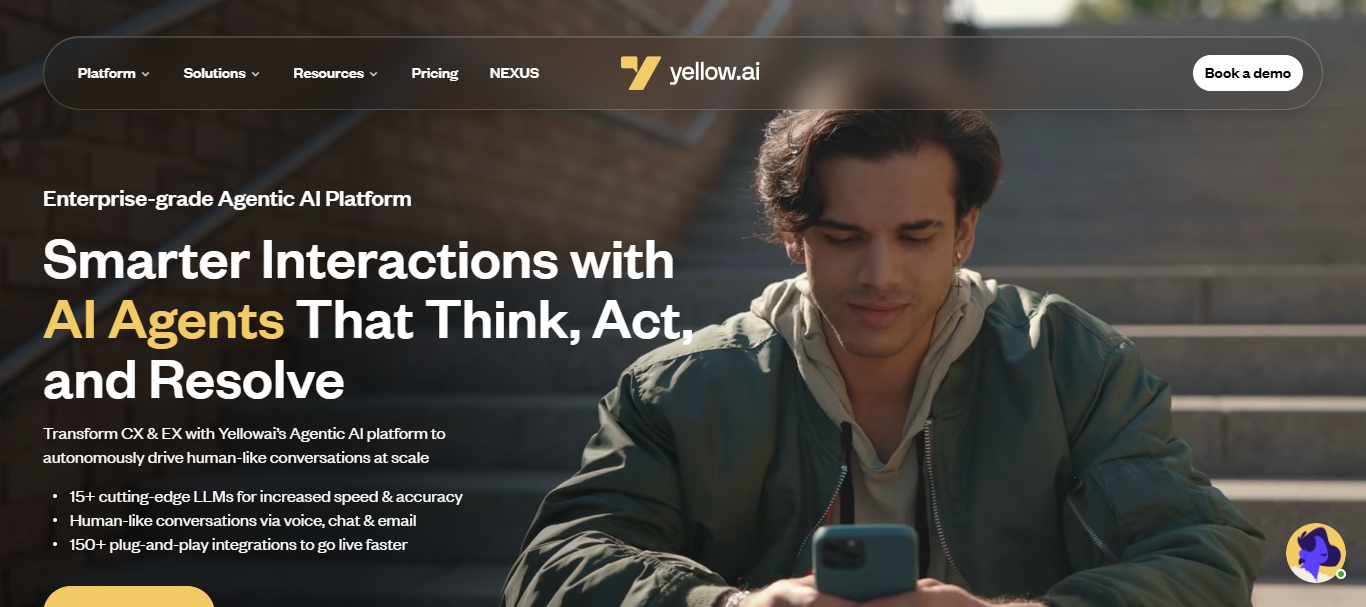
Yellow.ai is one of those platforms that shows up when a company has clearly outgrown basic chatbots and is now dealing with scale problems like huge ticket volumes, multiple channels, and customers speaking different languages across regions.
Instead of positioning itself as just a conversational AI tool, it leans into what it calls agentic automation, meaning the system is designed to take actions across business tools, not just respond to messages.
In practice, this is why it often comes up when teams evaluate Sierra AI competitors for global support operations.
Key Features
- Multi-channel support across messaging apps, email, voice, and web
- AI agents that can answer queries and execute workflows
- Multi-LLM orchestration for handling different types of requests
- No-code builder for faster deployment of bots and assistants
- Analytics layer for tracking conversation performance and automation success
Pros
- Works well for large, global support environments
- Strong multilingual capability compared to many alternatives to Sierra AI
- Better suited for automation-heavy use cases than simple chatbot platforms
Cons
- Setup can become complex as workflows scale
- Pricing is not always transparent upfront
- Needs careful design to avoid over-engineering bots
Best For
Teams running high-volume, multi-region customer support where automation needs to go beyond chat and actually plug into business operations.
6. Intercom Fin AI
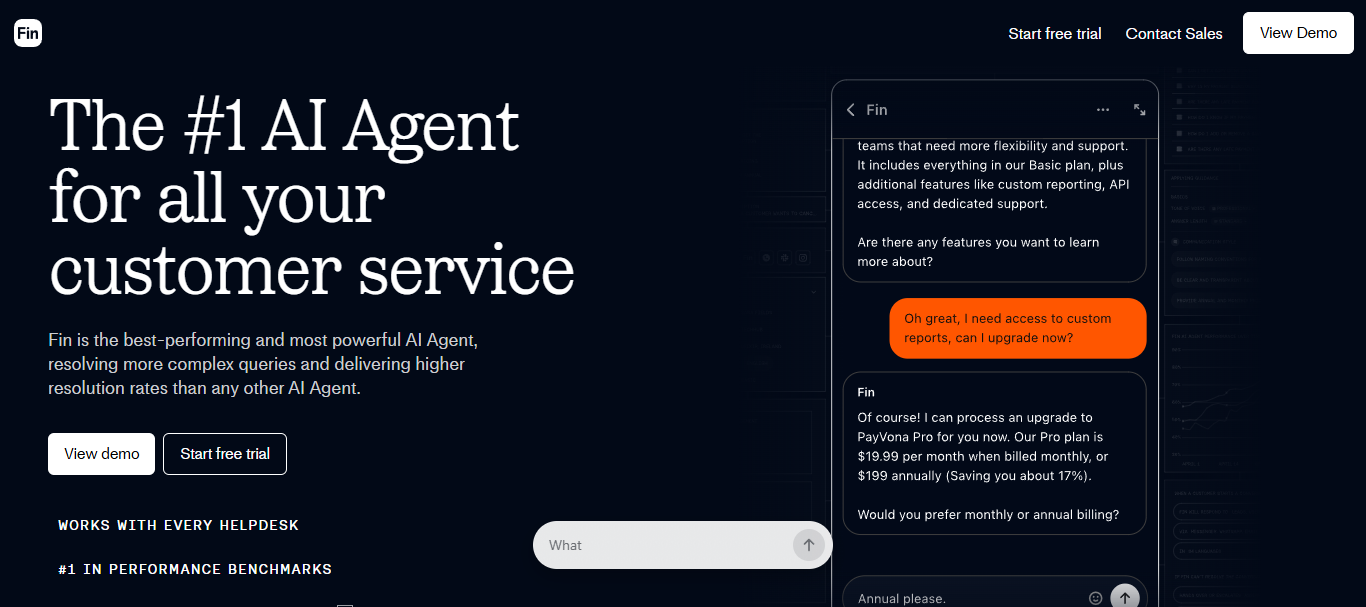
Fin AI is Intercom’s AI support assistant, built to sit directly inside customer support workflows. In most cases, companies don’t adopt it as a “conversation platform” in isolation; they use it as an upgrade to existing support operations where live agents and automation work side by side.
Compared to many Sierra AI competitors, Fin is more opinionated in its design. It focuses heavily on resolving support queries end-to-end using an organization’s help center content, past tickets, and support knowledge base. That makes it feel like a ready-to-deploy resolution engine.
Key Features
- AI agent that resolves customer queries using the help center plus past conversations
- Deep integration with Intercom’s messaging and support inbox
- Context-aware responses based on customer history and intent
- Seamless handoff to human agents when escalation is needed
- Analytics focused on resolution rate, deflection, and response quality
- No-code setup for activating AI on existing support content
Pros
- Very fast to deploy compared to enterprise-heavy platforms
- Strong at resolving repetitive support queries without agent involvement
- Works naturally inside existing support workflows
- Good visibility into AI resolution performance
Cons
- Limited flexibility outside Intercom’s ecosystem
- Less suitable for complex, multi-system automation
- Not ideal for deep custom conversational design
Best For
It tends to work best in fast-moving SaaS and digital-first companies where support volume is high but structured around repeatable questions.
7. Ada
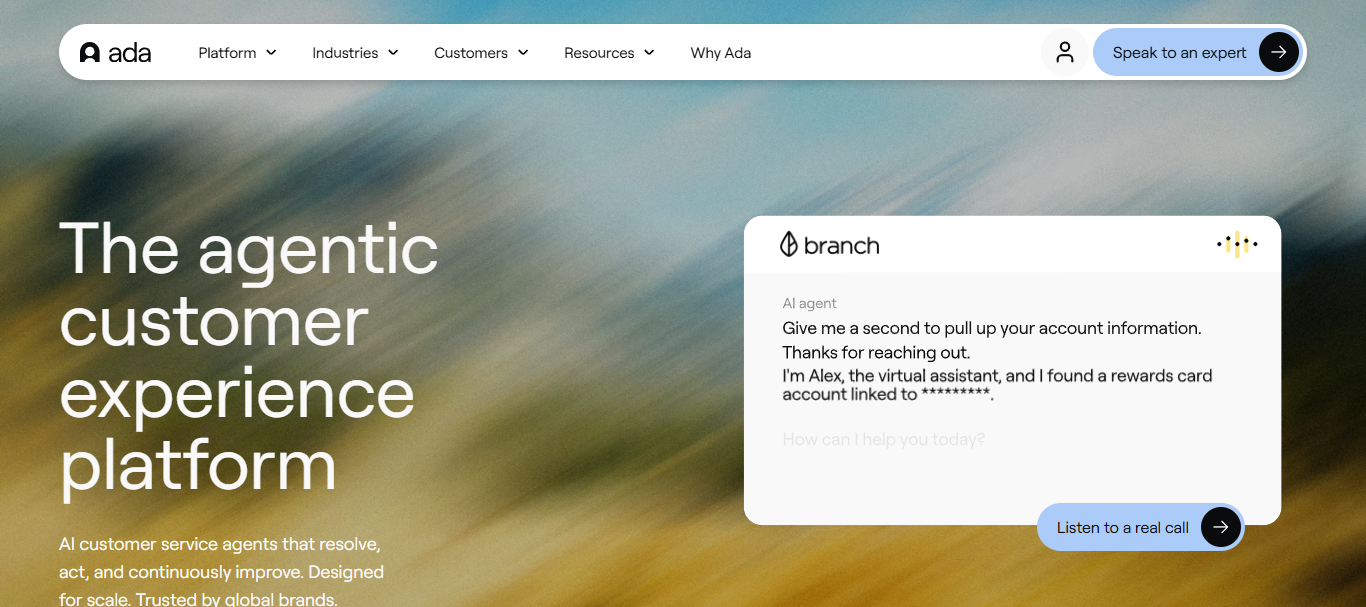
Ada is one of the more “enterprise-native” platforms in the Sierra AI competitors space, and it shows in how it’s designed. It behaves more like a full customer service automation layer that sits on top of support operations and quietly handles resolution in the background.
What stands out immediately is its focus on autonomous resolution rather than deflection. Many platforms stop at suggesting answers or routing tickets, but Ada is built around resolving the entire request using what it calls a reasoning engine combined with structured “playbooks.”
In practice, this means it can take a customer request, pull context from internal systems, and complete actions like updating records or processing simple transactions without human intervention.
Key Features
- AI agent system built on a reasoning engine + playbook workflows
- Omnichannel support (chat, voice, email, SMS, social)
- Strong API-driven integrations with backend business systems
- Multilingual support for global customer bases
- Performance dashboards focused on resolution rate and automation efficiency
Pros
- Strong at end-to-end resolution, not just answering questions
- Handles large-scale enterprise support environments well
- Good governance and control over automated workflows
- Proven at reducing live agent dependency in repetitive queries
Cons
- Less intuitive for teams wanting a lightweight setup
- Implementation often requires structured onboarding and planning
- Can feel rigid if workflows are not well-designed upfront
Best For
Large enterprises that want to push beyond chatbot-style support and actually automate resolution-heavy customer service workflows across multiple channels and regions.
8. Moveworks
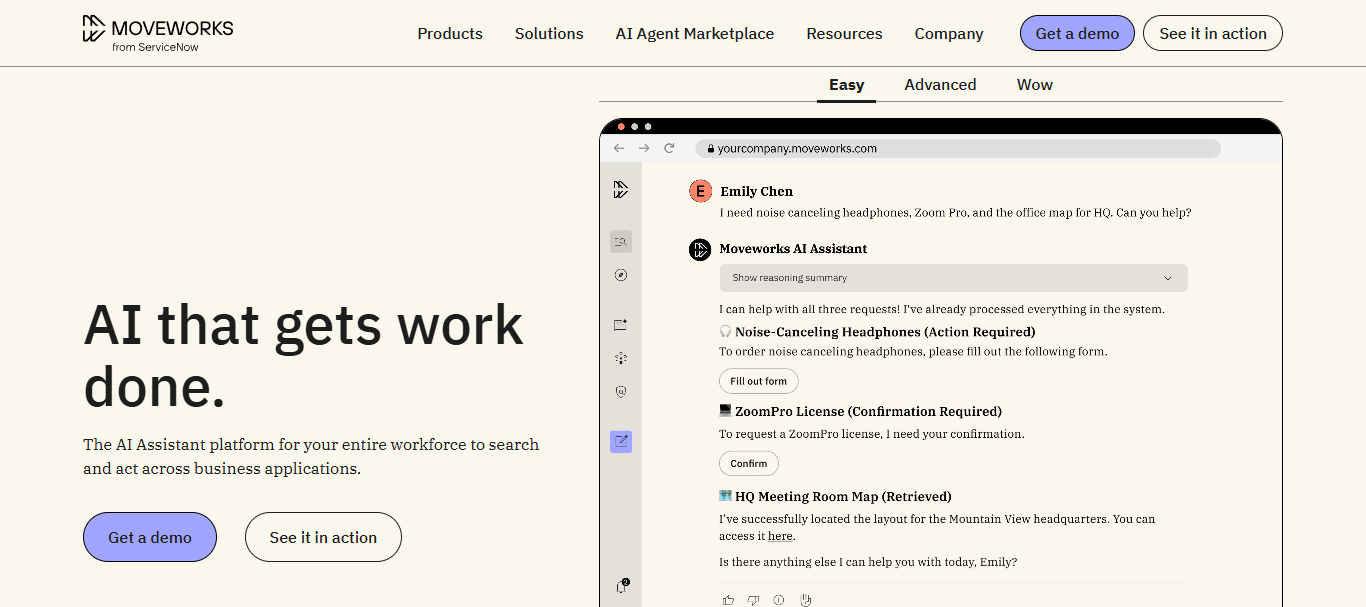
Moveworks is suitable for companies that have one recurring problem: employees keep asking the same operational questions in different places, such as Slack, Teams, email, IT portals, etc., and nothing is really connected behind the scenes.
It works directly inside Slack and Microsoft Teams as an internal help desk that can automate tasks and complete requests. If someone types “I need access to Salesforce,” it checks identity permissions, routes the request, and in some cases completes the access flow automatically if everything is approved.
That’s why it often gets grouped with Sierra AI competitors, but it’s solving a slightly different layer of the problem. It’s not trying to manage customer conversations; it’s trying to reduce internal noise inside large organizations where IT and HR teams are overloaded with repeat requests.
Key Features
- Resolves internal IT and HR requests directly inside Slack/Teams
- Can trigger real actions like password resets or access provisioning
- Searches across internal tools and documentation
- Integrates with systems like ServiceNow, Jira, and identity platforms
- Automates repetitive employee service workflows
Pros
- Actually reduces ticket volume, not just organizes it
- Works where employees already spend their time
- Strong at connecting fragmented internal systems
Cons
- Only makes sense in large, complex enterprise environments
- Requires heavy backend integration to be useful
- Not designed for customer-facing conversational AI
Best For
Companies where internal support demand has become a scaling problem, especially IT-heavy organizations with lots of tools and repetitive employee requests.
9. Retell AI
Retell AI is mostly used when companies don’t want to deal with traditional call center infrastructure but still need automated phone conversations that don’t feel scripted.
It’s built around real-time voice interaction rather than chat-based flows. So instead of users pressing buttons or moving through rigid IVR menus, the system can carry natural spoken conversations.
Compared to broader Sierra AI competitors, it’s narrower in scope but faster to deploy for voice-specific workflows. You wouldn’t typically use it to manage omnichannel support or internal employee requests.
Key Features
- Real-time AI voice conversations over phone calls
- Low-latency response handling for natural turn-taking
- LLM-based dialogue management instead of static call flows
- API-first structure for connecting backend systems
- Custom voice agents for outbound and inbound use cases
- Call recording and basic analytics
Pros
- Feels more natural than traditional IVR systems
- Quick setup for specific voice automation use cases
- Works well for repetitive outbound calling tasks
Cons
- Limited beyond voice use cases
- Needs developer effort for integrations
- Not built as a full CX or enterprise automation platform
Best For
Organizations looking to automate inbound and outbound voice conversations.
Sierra AI vs Other Conversational AI Platforms
When teams look at Sierra AI competitors, the real question is usually how much control they’ll still have after everything is up and running.
| Feature | Sierra AI | Other Alternatives |
|---|---|---|
| Enterprise Readiness | Strong focus on customer service use cases | Varies by platform and industry |
| Customization | Moderate customization options | Ranges from low-code builders to fully open-source frameworks |
| AI Capabilities | Customer-facing conversational AI | Voice AI, agentic AI, employee AI, workflow automation |
| Workflow Coverage | Primarily customer support | Customer support, IT, HR, and enterprise operations |
| Deployment Flexibility | Guided implementation | Plug-and-play, low-code, or self-hosted options |
How to Choose the Right Sierra AI Alternative?
Choosing between different Sierra AI alternatives usually comes down to how the platform fits into your existing business processes, support operations, and long-term goals.
When evaluating your options, consider the following factors:
Business Size and Scalability
- Smaller teams often prefer platforms that are easy to deploy and require minimal technical effort.
- Larger organizations may prioritize customization, workflow control, and long-term scalability.
Industry Requirements
- Businesses in regulated industries such as finance and healthcare should prioritize security, compliance, and governance capabilities.
- Other industries may place greater emphasis on speed, flexibility, and ease of implementation.
AI Maturity
- Organizations that are new to conversational AI often benefit from plug-and-play solutions.
- Businesses with existing AI investments may require deeper integrations and greater control over how AI agents behave.
Support Channels
- Some companies only need AI-powered chat support.
- Others require coverage across voice, email, messaging apps, social media, and additional customer touchpoints.
Integration and Customization Needs
- Evaluate how well the platform connects with your CRM, support tools, and business systems.
- Consider whether you need the flexibility to customize workflows, prompts, automations, and conversation logic.
Implementation Complexity
- Some platforms can be deployed in days, while enterprise-grade solutions may require weeks or months of implementation and configuration.
Which Sierra AI Alternative Is Right for You?
The space around Sierra AI alternatives is expanding quickly, and each platform we covered solves a slightly different problem. Some are built for customer support at scale, others focus on internal automation or highly customizable AI workflows.
There’s no single “best” option that works for everyone. You should analyze how complex your setup is and how deeply the AI needs to connect with your existing systems.
What’s clear is that alternatives to Sierra AI are becoming more specialized, which makes it easier to match a tool to your use case, but also more important to evaluate carefully before committing.
If you’re looking for an enterprise-ready customer experience platform with conversational AI, workflow automation, and AI-powered support capabilities, explore Kapture CX and book a personalized demo.
FAQs
Some platforms offer modular setups that smaller teams can adopt and scale over time, while others are designed primarily for enterprise use cases.
The platform determines this. While some (such as open-source or developer-first solutions) require technical setup and continuous engineering assistance, others provide no-code builders for simple use cases.
Plug-and-play technologies can be implemented in a few days. Enterprise-grade solutions require extensive integrations, which may take many weeks or months.
Most modern conversational AI platforms integrate with CRMs, help desk software, and enterprise systems, although the depth of integration varies by vendor.
Many teams focus only on features and ignore operational fit, like scalability, maintenance effort, and how well the AI aligns with real support workflows.



 +1833-386-0222 (USA)
 enquiries@kapture.cx