













TL;DR
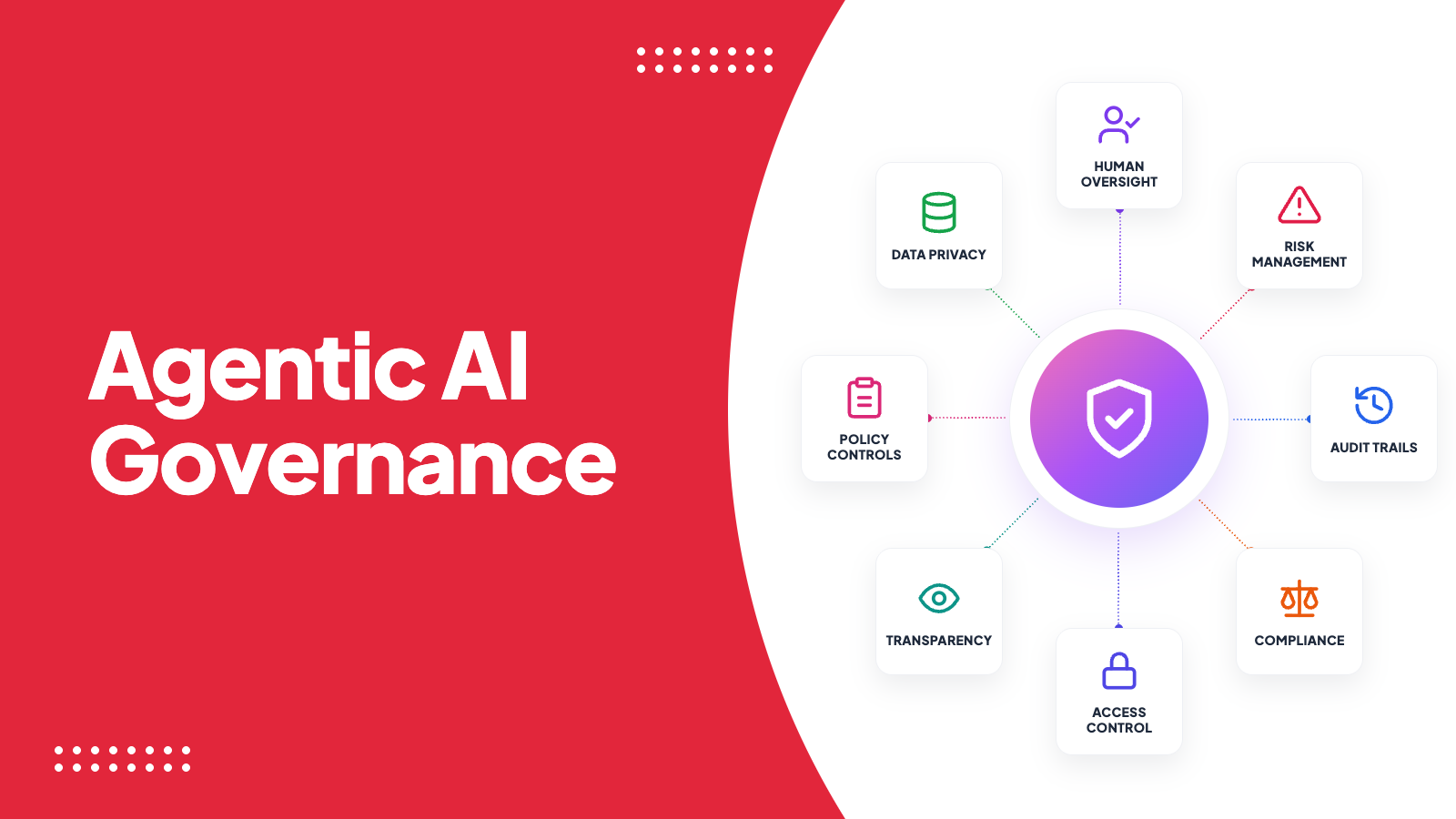
Agentic AI governance sets the controls, accountability and oversight needed when AI agents act across customer service workflows. It covers permissions, policy boundaries, data access, escalation, and evaluation. As customer expectations evolve, governance must also preserve a clear route to human support and make agent actions traceable.
Platforms such as Kapture AgentOS support these efforts through agent monitoring, human intervention, audit trails, and operational analytics.
Key Takeaways
- Treat governance as an operating model with named owners, not a one-time technical setup.
- Match an agent’s autonomy to the financial, privacy, and customer impact of its actions.
- Give customers a clear path to human support, especially when an automated resolution fails.
- Measure policy adherence and customer outcomes alongside speed and containment.
- Reassess controls whenever workflows, connected systems, or agent responsibilities change.
- Use audit evidence to investigate incidents and improve the operating model.
When a customer reports that a product arrived damaged, an AI agent might verify the order, check the refund policy, issue an eligible refund, and close the ticket within minutes. The customer receives a quick resolution, and the support queue keeps moving.
But what if the refund exceeds the agent’s authority? Or the ticket closes before anyone investigates a larger issue?
A single incorrect action can turn a routine support interaction into a costly mistake, particularly when an agent can change records, issue compensation, or trigger downstream workflows. This represents a significant shift from AI systems that primarily answered questions or recommended next steps.
MarketsandMarkets projects that the global agentic AI market will grow at a 40.2% compound annual growth rate from 2026 to 2033, reaching $205.88 billion. This is a market forecast, not proof that agentic AI will be adopted everywhere. However, it signals growing commercial interest in systems that can execute workflows, making governance an important part of deployment planning.
What Is Agentic AI Governance?
Agentic AI governance is the set of policies, controls, and oversight that defines what AI agents can do, which decisions they can make on their own, and when they need human approval. It is a specialised part of broader AI governance, focused on AI systems that take actions rather than only generate answers.
In customer service, agentic AI governance could mean letting an agent approve a small refund independently. But on the other hand, larger amounts would require human scrutiny. Similarly, the rules apply as AI agents access customer records, update accounts, and handle complaints.
Why AI Agents Need Different Governance Than Traditional AI
Traditional AI usually provides an answer or recommendation. AI agents can take things further by autonomously acting on these answers or recommendations. Governance must therefore account for this core difference.
| Area | Agentic AI Governance | Traditional AI Governance |
| Primary focus | Agent actions, permissions, and outcomes | Accuracy, fairness, privacy, and responsible outputs |
| Decision-making | Defines which decisions agents can make independently | Evaluates the reliability of predictions and responses |
| System access | Governs access to tools, APIs, data, and business systems | Governs access to data used by AI models |
| Execution | Sets limits on actions agents can take | Evaluates outputs before they are acted upon |
| Human oversight | Defines approval rules and escalation triggers | Focuses on output review and exception handling |
| Risk management | Addresses unauthorized actions, record changes, and workflow failures | Addresses bias, inaccurate outputs, and data exposure |
| Monitoring and auditing | Tracks agent decisions, tool calls, actions, and outcomes | Tracks model performance, output quality, and compliance |
| Accountability | Assigns responsibility for agent actions and their consequences | Establishes responsibility for model performance and use |
| Multi-agent coordination | Governs how agents delegate tasks and work together | Typically focuses on individual models or AI applications |
Risks of Missing Agentic AI Governance in Customer Service
Governance for AI agents prevents mistakes. The failure points could otherwise cost money, expose customer data, create compliance risks, and even damage customer trust. Common failure points include:
1. Unauthorized Refunds and Compensation That Eat Into Revenue
Suppose a delivery is delayed and the agent offers both a refund and a discount, even though company policy allows only one. Repeated across hundreds of requests, this kind of policy failure can create avoidable costs.
Agents need defined spending limits. Human review prevents revenue leaks for cases that exceed those limits or fall outside the usual policy.
2. Sensitive Customer Data Exposed Due to Unnecessary Access
An agent resolving an order query may not need access to a customer’s full account history or payment details. Yet broad permissions can make that information available. The agent may share sensitive data in responses. Or worse, pass it into another system unnecessarily.
Access should match the task. Agentic AI governance controls what agents retrieve, include in replies, and share with connected systems.
3. Compliance Risks When AI Agents Handle Regulated Services
A wrong answer about an insurance exclusion or a bank’s financial product can have consequences beyond a poor support experience. Customers may act on that information, and the business could face compliance issues.
Agents handling regulated services need rules that reflect the relevant requirements. Questions involving policy interpretation, financial guidance, or decisions outside an agent’s authority should go to a qualified employee.
4. Unverified Promises That Erode Customer Trust
A customer wants to know when their replacement will arrive. The agent confirms next-day delivery without checking whether the item is in stock or ready to ship. Any delay will upset the customer.
The same goes for discounts or fee waivers the agent can’t offer. These small assurances can quickly turn into bigger service issues. Agents should check the facts and stay within their approval limits before making promises.
5. Missed Escalations That Leave Customers Without Help
Consider a customer who has disputed an insurance claim twice. Each time, the agent sends the same standard response. The customer is still waiting for an explanation. Nothing has moved forward. At this point, another scripted reply will only add to the frustration.
The case needs someone who can review the decision and explain what happens next. Teams should set clear rules for when an agent must hand over a conversation, including repeated failed attempts, disputed decisions, and requests for human help. The handover should include what’s happened so far, so the customer doesn’t have to tell the whole story again.
Customer research supports this expectation. Gartner reported in August 2026 that 87% of surveyed customers considered access to a human agent essential when a company uses generative AI in customer service.
Key Challenges in Governing AI Agents for Customer Service
Keeping track of customer service decisions and actions gets harder when AI agents handle customer requests from various systems. Addressing AI agent governance challenges offers more freedom without loss of control.
McKinsey’s 2026 State of AI survey found that 40% of respondents at organizations with more than $1 billion in annual revenue said they were scaling AI agents, up from 27% in the previous year. Yet only 37% of respondents said AI had contributed to enterprise-level EBIT. This gap highlights a key governance challenge: organizations must evaluate AI agents against measurable business outcomes, rather than relying solely on deployment scale or automation rates.
Teams should stay mindful of:
- Tracing agent decisions: When an agent takes several steps to resolve a request, it can be difficult to work out where things went wrong or why it took a particular action.
- Establishing accountability: When an agent makes a mistake involving multiple systems or teams, identifying who is responsible can get complicated.
- Balancing speed with oversight: Too many approval steps slow down routine requests. Too few can leave risky decisions unchecked.
- Keeping reliable audit records: Teams need clear records of agent actions, approvals, and decisions to investigate incidents and meet compliance requirements.
- Controlling access to data and systems: Agents need enough access to do their jobs, but broad permissions can expose customer information or allow unauthorized changes.
- Enforcing policies consistently: Agents may struggle when a request falls outside standard procedures or when instructions conflict. Teams need clear rules for handling these situations.
- Catching errors early: An incorrect response or action can affect several steps in a customer interaction before anyone spots the problem.
- Coordinating multiple agents: When agents share a case or pass work between them, tasks can overlap, actions can conflict, and ownership can become unclear.
Agentic AI Governance Framework for Customer Service
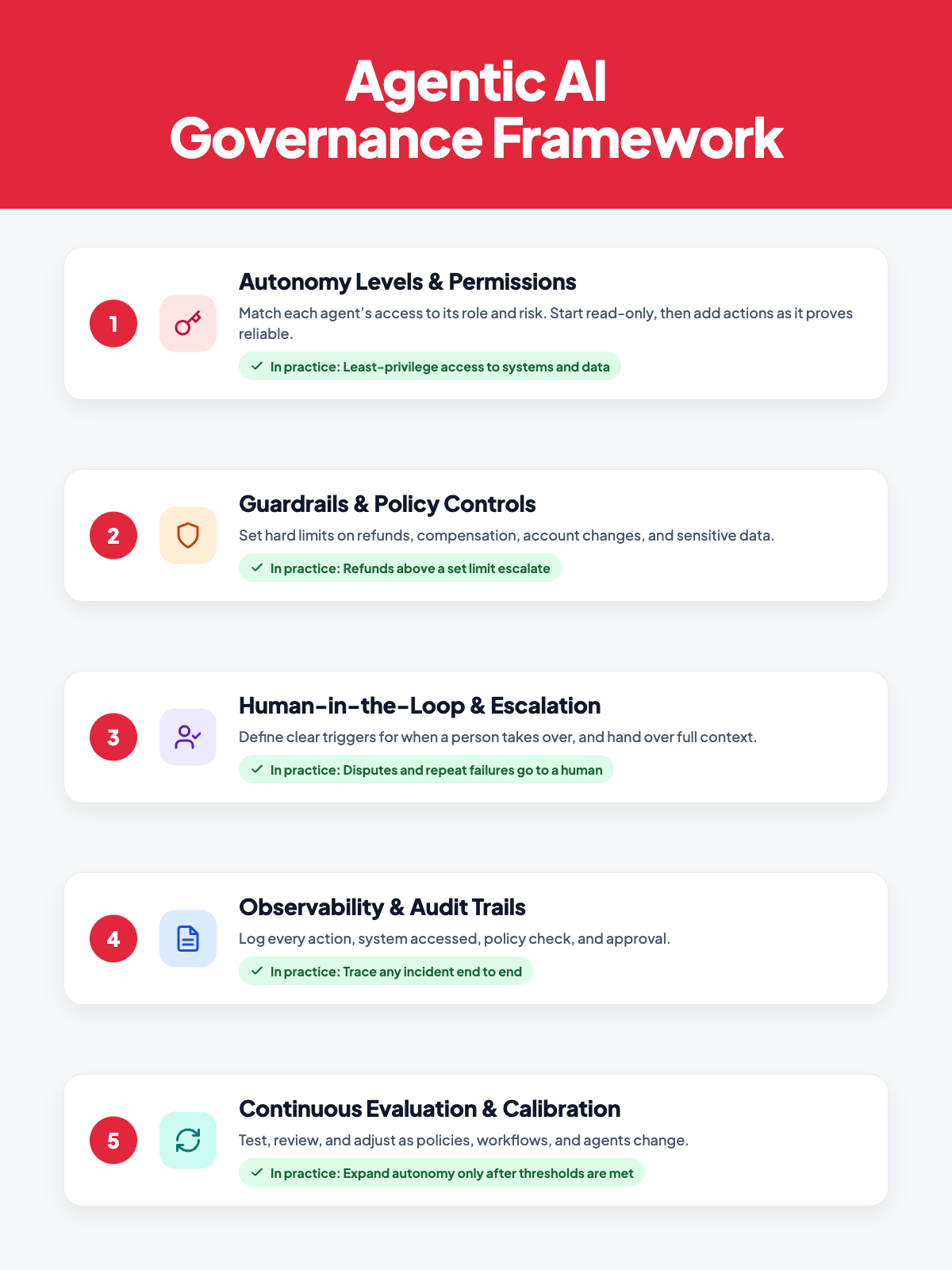
An effective agentic AI governance framework defines what customer service agents can do independently, where controls apply, and when human intervention is required. These five pillars help teams manage risk while giving agents room to handle routine work.
1. Autonomy Levels and Permissions
Not every AI agent needs the same level of autonomy.
A basic support agent may retrieve information and suggest responses, while a more autonomous agent may update customer records or complete approved requests independently.
Define each agent’s permissions based on its role, risk level, and business purpose. Start with read-only access, then introduce actions as the agent proves reliable. Apply the principle of least privilege so agents access only the systems and data they need.
2. Guardrails and Policy Controls
Guardrails keep agent actions within business rules.
Define limits for refunds, compensation, account changes, and access to sensitive information. Specify which actions are prohibited and which require additional checks.
For example, an agent may approve refunds below a set threshold but must escalate larger amounts. Build these rules into workflows and system permissions wherever possible. Instructions alone may not prevent an agent from taking an unauthorized action.
3. Human-in-the-Loop and Escalation Rules
Human oversight should depend on the situation and its potential impact.
Set clear triggers for escalation, such as disputed claims, unusual refund requests, repeated resolution failures, or customer requests to speak with a person. Define when an agent needs approval before proceeding and when it must stop entirely.
When handing over a case, the agent should provide the conversation history, relevant checks, and actions already taken. This helps human representatives make informed decisions without restarting the interaction.
4. Observability and Audit Trails
Teams need visibility into agent activity to identify errors and investigate incidents.
Record the actions an agent takes, the systems it accesses, the policy checks it performs, and the outcome of each task. Include relevant decision context and details of any human approvals or escalations.
These records help teams understand how an incident occurred and whether the agent followed its permissions. They also provide evidence for internal reviews and compliance reporting.
5. Continuous Evaluation and Calibration
Governance needs regular review as customer needs, business policies, and agent behavior change.
Test agents against common requests, unusual scenarios, and attempts to bypass established rules. Review customer interactions for incorrect responses, unauthorized commitments, and missed escalations. Use these findings to adjust instructions, permissions, and workflows. Reassess access whenever an agent takes on new responsibilities.
Teams should also define clear performance thresholds before granting agents greater autonomy.
Agentic AI Governance Best Practices for Customer Service Teams
Customer service teams need clear rules for when AI agents can resolve a request independently and when a person must take over. These practices help embed those rules into daily operations.
- Map the workflow first: Map out how a request moves through the business, including common exceptions, connected systems, and the teams responsible for the outcome. This helps identify gaps before automation begins.
- Start with a limited rollout: Start with a small group of customers, one support channel, or a specific type of request. Expand the rollout once the agent consistently meets your quality, service, and risk requirements.
- Plan a kill switch: Decide how to pause an agent if it starts making mistakes. Teams should also know how to handle pending transactions and recover affected customer cases.
- Version every change: Record changes to prompts, policies, knowledge sources, and connected tools. This makes it easier to investigate problems and understand which configuration was active when an incident occurred.
- Measure outcomes, not volume: Track business outcomes, not just automation volume. Monitor repeat contacts, reopened cases, customer satisfaction, policy exceptions, cost per resolution, and the rate of successful handoffs.
- Train your team: Train employees to understand what agents can do, recognize when their decisions need review, and report unexpected behavior. Make sure staff know how to step in when a case requires human judgment.
- Vet vendors before connecting: Before connecting an AI agent to customer systems, clarify how customer data is stored, how incidents are reported, how access can be revoked, and whether audit records can be exported.
How Kapture Approaches AI Agent Governance
Kapture’s AgentOS brings agent execution, human oversight, quality auditing, and operational analytics into one system. Its four components address different parts of AI agent governance.
- Vitos Agent Builder helps teams create agents for voice, chat, email, and social channels, orchestrate multi-step workflows, and test agents against edge cases before launch.
- Command, the Human Layer, defines where human oversight applies. Teams can review agent activity, route approvals, and take over a live process.
- Calibrate, the Audit Layer, monitors agent and human interactions against defined standards. Its listed functions include logging interactions against SLAs, automatically assessing quality and adherence, and turning gaps into coaching opportunities.
- Pulse, the Intelligence Layer, supports querying operational data, identifying patterns, recommending actions, and executing recommendations.
For robust enterprise AI agent governance, AgentOS includes role-based access controls, audit trails, and prompt and response logging with PII redaction. Real-time dashboards, alerts, and rollback capabilities support monitoring and incident response.
Together, these capabilities help customer service teams define agent boundaries, retain human oversight, and improve service quality as AI agents take on more responsibility.
FAQ
Effective frameworks combine clear ownership, risk-based permissions, policy controls, human escalation, auditability, and ongoing evaluation. They should also define measurable thresholds for accuracy, customer outcomes, and policy compliance, with a process for pausing or rolling back an agent when performance deteriorates.
Enterprise platforms may offer agent building, workflow controls, human approvals, interaction auditing, and operational analytics. Evaluate each product against your own requirements for access management, logging, data handling, integration, and incident response rather than assuming that every governance feature is included.
Yes, within predefined limits. They can handle low-value, policy-compliant refunds when transaction limits and eligibility checks are enforced. Refunds above approved thresholds or outside company policy should require human approval.
Enterprise AI agent governance is the organization-wide set of policies, technical controls, ownership structures, and review processes that govern how AI agents access data, use tools, make decisions, and coordinate across systems.



 +1833-386-0222 (USA)
 enquiries@kapture.cx