














On September 12, Anthropic’s Dario Amodei published an essay calling on frontier AI labs to slow the rate at which they improve model capabilities. Within hours, OpenAI’s Sam Altman and xAI’s Elon Musk said they agreed. Three companies that compete for the same enterprise contracts, the same researchers, and the same headlines landed on the same position in a single day.
What the essay proposes
Amodei’s essay argues that AI systems are increasingly able to help build the next generation of AI, a dynamic researchers call recursive self-improvement. Left unchecked, he argues, the pace of that improvement could outrun the industry’s ability to monitor and steer what it builds.
The plan has three steps.
- First, frontier labs give independent evaluators permanent, employee-level access inside their own companies, so outside reviewers can check safety claims directly rather than take a lab’s word for it. Anthropic committed to this step unilaterally, effective immediately.
- Second, frontier labs within democratic countries coordinate on shared safety standards and shared limits on the rate of capability growth, a step Amodei acknowledges would need a narrow antitrust waiver from Washington.
- Third, democratic governments attempt to coordinate with authoritarian governments on verification.
Amodei is explicit that pacing is not pausing. Training continues. Progress continues. The claim is narrower: capability growth should be metered against the industry’s ability to verify what it is building, not against how fast a lab can ship.
Who agreed, and why that’s the notable part
Roughly two and a half hours after the essay went up, Altman posted his agreement, matched Anthropic’s evaluator commitment, and added that OpenAI would do the same, while drawing the identical line Amodei drew: pacing is not stopping, and progress stays rapid. Musk’s reaction was three words: Dario is right. Google DeepMind’s Demis Hassabis endorsed the proposal as well.
The alignment matters mainly for who is in the room. Altman, Amodei, and Musk have spent years disagreeing publicly and in court. One weekend produced three separate statements landing on the same sentence.
The disagreement underneath the agreement
The endorsements arrived faster than the scrutiny, and the scrutiny is substantive.
Stability AI founder Emad Mostaque argued the plan’s only enforcement mechanism, the embedded evaluators, could be disregarded without real consequence.
David Sacks, who chairs the President’s Council of Advisors on Science and Technology, made a sharper argument. His position is not that pacing is wrong. It’s that Anthropic and OpenAI already sit at the frontier by every measure that matters, market share, revenue growth, model capability, and don’t need government cover to slow down voluntarily. He argued companies should stop pretending they need anyone else’s permission to do it, or that antitrust law needs to bend to let rivals coordinate. He also questioned the altruism framing directly, pointing to the product-liability exposure both companies carry if their systems enable a damaging cyberattack, and arguing that trading some capability for predictability is simply good business regardless of how it gets described. Separately, he noted that any global tier of the plan depends on participation from China, which he does not expect to join a voluntary agreement to slow down.
A related reading treats voluntary pacing as a mechanism that raises the cost of staying at the frontier, in compute, data, and safety overhead, regardless of anyone’s intent, and those costs fall hardest on labs without deep balance sheets. Open-weight labs, including Alibaba’s Qwen team and DeepSeek, have kept shipping on their own schedule, unbound by any pacing commitment among US labs. Between a US duopoly that may or may not restrain itself and open-weight labs that were never asked, the gap does not close by itself.
What this changes for enterprise AI buyers
None of this is a lab-internal argument. Every enterprise running production AI workloads is a counterparty to whichever version of it resolves.
If pacing holds, the capability gap between frontier labs narrows, because the leaders move at a similar speed by agreement. Model selection stops being a bet on which lab is fastest this quarter and becomes a question of which architecture can absorb an audit, show what a model did and why, and hold a human accountable at the point where it matters. That is a procurement question, not a research question.
If pacing does not hold, or holds only among two US labs while open-weight development continues elsewhere, the gap between paced and unpaced labs widens unevenly and without warning. Enterprises that built their CX stack around one model’s roadmap inherit that unpredictability directly. Enterprises that built an orchestration layer capable of swapping the intelligence underneath, without rebuilding the workflow around it, inherit a preference, not a crisis.
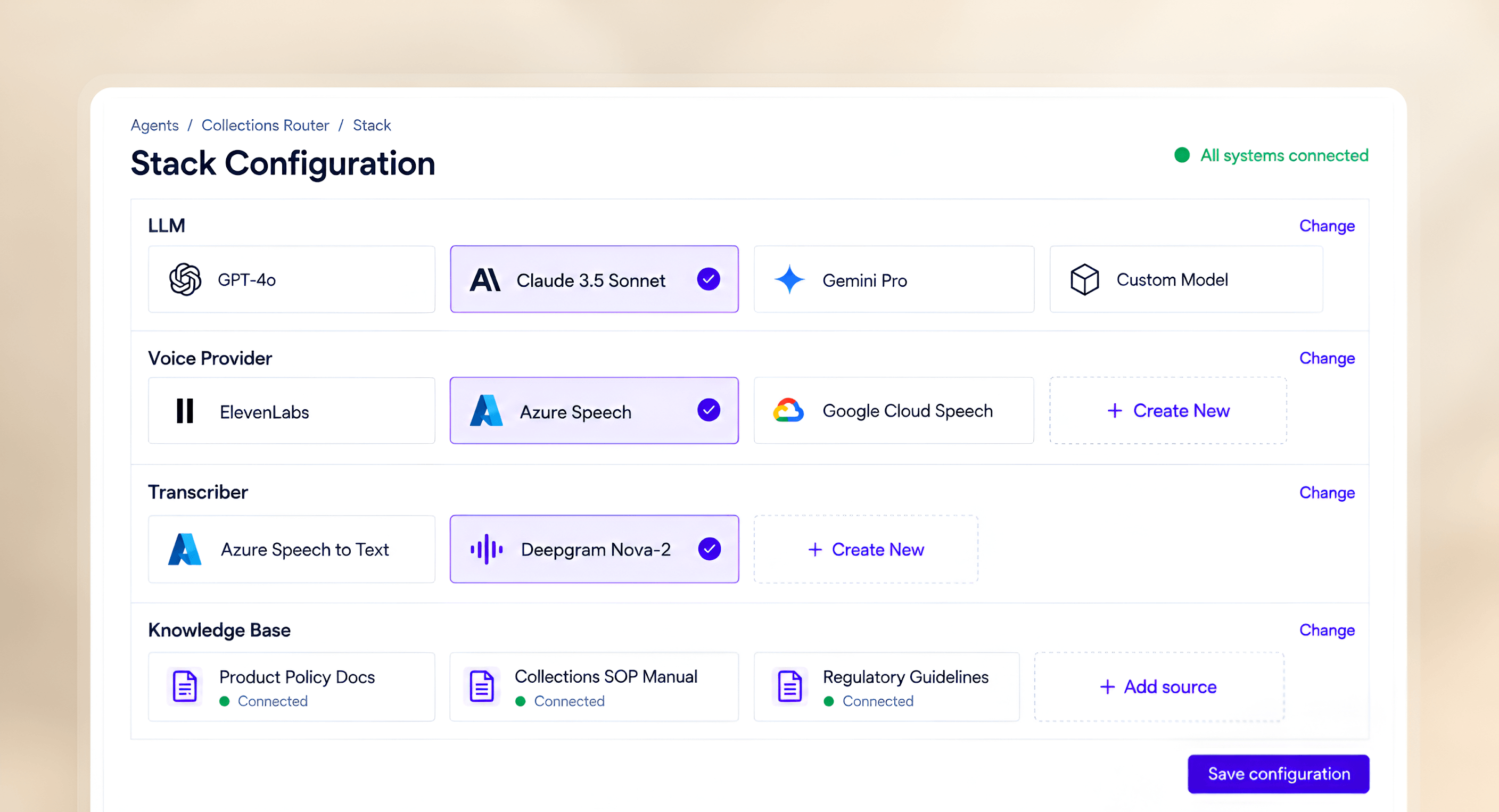
Either outcome argues for the same design discipline: the model is a component, not the architecture. Oversight, audit, and escalation belong at the layer above any single model, where they hold regardless of how the frontier argument resolves.
Kapture’s AgentOS puts that layer to work at the operational level: Command for human oversight and escalation, Calibrate for quality auditing, independent of which model sits underneath.
See how we’ve helped leading retail & BFSI enterprises stop managing work, and start completing it.
Other blogs you’d love to read
Explore the advancements in CX and AI through Kapture.

Your Plan. Your Value. Your Growth.
Your business is different – and the pricing should reflect that.
Let’s build a plan that matches your goals, maximizes ROI, and scales with your success.
 +1833-386-0222 (USA)
 enquiries@kapture.cx