













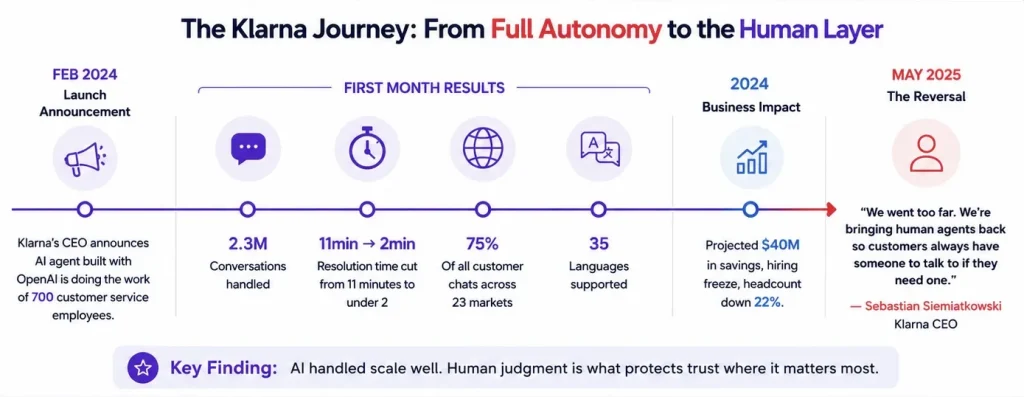
In February 2024, Klarna’s CEO announced that the company’s AI agent, built with OpenAI, had done the work of 700 customer service employees in its first month. The numbers behind the claim were striking: 2.3 million conversations handled, resolution time cut from 11 minutes to under 2, and the agent managing 75% of all customer chats across 23 markets and 35 languages. Klarna projected $40 million in savings for the year, froze hiring, and watched headcount fall by 22%. Sebastian Siemiatkowski called the company OpenAI’s “favorite guinea pig.” For a year, Klarna was the reference case the entire industry pointed to when arguing that full autonomy in customer service had arrived.
By May 2025, the story had changed. Siemiatkowski told Bloomberg that Klarna had gone further than it should have, and that the company was bringing human agents back so customers always had someone to talk to if they needed one. Internal reviews found that satisfaction had declined specifically on complex service interactions, and that some of the projected savings hadn’t materialized as expected. The stated reason wasn’t that the AI performed poorly across the board. It was that the system lacked the empathy and judgment that certain categories of conversation required.
The detail worth sitting with is which categories those were. The employees Klarna rehired weren’t brought back for routine volume. They were brought back specifically for disputes, hardship cases, and complex refunds, the exact interactions where a wrong or tone-deaf response costs the most, in trust as much as in revenue.
Two different claims got treated as one
It’s easy to read this as a story about AI falling short. That reading misses what actually happened. The public data on AI-handled customer service, taken as a whole, doesn’t support “AI struggled here.” Ecommerce companies running autonomous agents report resolution rates between 76% and 92%, depending on ticket type. AI-native platforms are achieving 55-70% first-contact resolution with handle times under three minutes, against a 4-7 minute industry average for a human-assisted call. Traditional static self-service, by comparison, resolves only about 14% of issues. On the categories of work it was built for, the technology performed close to as advertised.
What this experience actually demonstrates is that “autonomous” and “handles everything well” are two separate claims, and the gap between them tends to surface only after deployment, once real customers bring real edge cases that a pilot never tested. That’s a pattern worth taking seriously, not because one company got it wrong, but because the broader data suggests this is closer to the norm than the exception.
The industry’s numbers tell a similar story
Across enterprises adopting AI agents generally, 79% have adopted some form of the technology, but only 31% run it in production. IDC’s research on AI pilots found that for every 33 proofs-of-concept built, roughly four ever reach full deployment. When Forrester examined why autonomous agent pilots stall, the answer wasn’t model quality. Most failures occurred during security review, governance implementation, or integration hardening, the operational scaffolding around the model, not the model’s ability to reason.
Governance maturity lags even further behind adoption. Gartner found only 21% of organizations have a mature governance model for autonomous AI agents in place, and more than 40% of agentic AI projects are expected to be cancelled by 2027, citing escalating costs, unclear business value, and inadequate risk controls. Only about 23% of organizations report significant ROI from AI agents at all.
Put together, these numbers raise a fair question worth asking honestly: has the industry been measuring the wrong milestone? Most of the public conversation over the past two years has centered on whether AI can hold a competent conversation. Comparatively little of it has centered on whether an organization actually knows, in advance, which conversations that same AI shouldn’t be handling alone.
What separates the deployments that hold up
The evidence points to a fairly consistent dividing line. Where AI is asked to resolve well-defined, high-volume, low-ambiguity requests, password resets, order status, standard account changes, it performs close to or on par with the strongest data points cited above. Where it’s asked to absorb disputes, emotionally charged escalations, or decisions that sit outside written policy, without a clear mechanism for recognizing that boundary and handing off appropriately, quality tends to erode in ways that don’t show up immediately. They show up in retention and CSAT data weeks or months later, which is part of why they’re easy to miss until the numbers force the question.
Klarna’s own language after the reversal supports this reading. The company didn’t describe the shift as reducing AI’s role. It described it as adding a human layer specifically for the categories of interaction that required judgment the AI wasn’t built to exercise, while the agent continued handling the bulk of routine volume it had always handled well.
Where this leaves the design question
The lesson isn’t that enterprises should use less AI in customer service, the data doesn’t support that conclusion, and the agent in this case remains in production handling the majority of its conversations today. The lesson is that a system built for full autonomy without a reliable way to recognize its own limits will eventually meet a case it shouldn’t handle alone, and the cost of that gap tends to show up in exactly the metrics that matter most, satisfaction, trust, retention, often well after the deployment has already been declared a success.
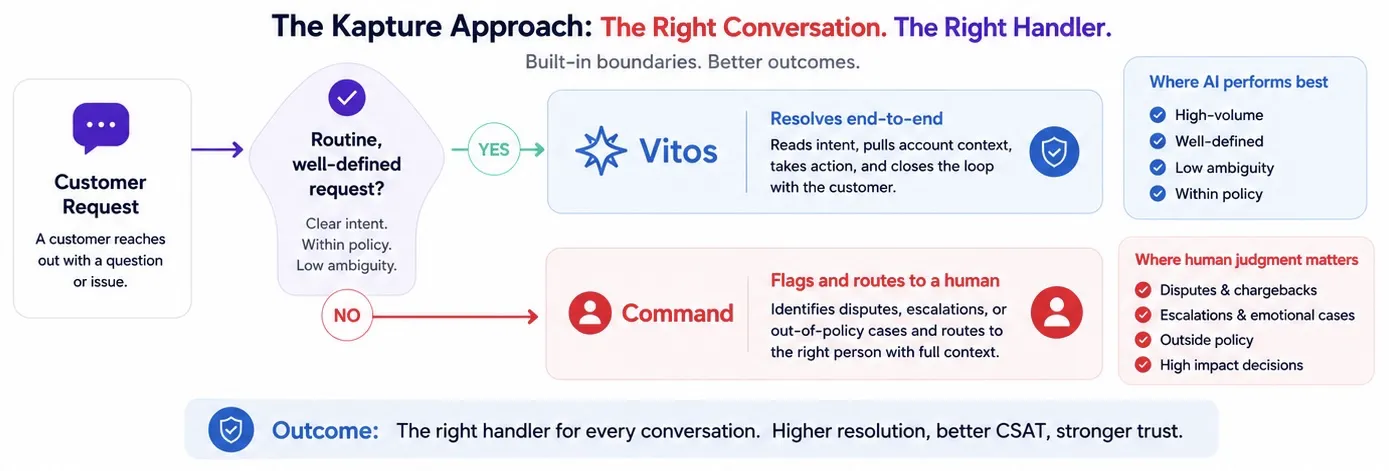
This is the distinction Kapture’s AgentOS is built around. Vitos handles resolution end to end for the categories of work AI genuinely does well, reading intent, pulling account context, closing the loop with the customer, the same territory where the industry-wide resolution-rate numbers above are strongest. Command exists specifically for the other boundary: recognizing the disputed charge, the escalation, the case that falls outside policy, and routing it to a person immediately, with full context already attached, rather than letting the gap surface later in a satisfaction survey.
This kind of public reversal gave the industry a documented, dated example of what happens when that boundary isn’t built in from the start. The broader adoption and governance data suggests this isn’t an isolated case so much as a pattern still playing out across enterprise AI generally. The organizations likely to hold up over the next few years aren’t necessarily the ones that automated the most. They’re the ones that built, from the outset, a clear and reliable answer to a narrower question: which conversations should this system never be handling by itself.
Get in touch to see it in production.
Other blogs you’d love to read
Explore the advancements in CX and AI through Kapture.
Your Plan. Your Value. Your Growth.
Your business is different – and the pricing should reflect that.
Let’s build a plan that matches your goals, maximizes ROI, and scales with your success.
 +1833-386-0222 (USA)
 enquiries@kapture.cx