













Ask most CX leaders how many systems it takes to handle a single customer interaction, and the honest answer is uncomfortable. A new ticket touches the CRM, then the helpdesk, then a chatbot vendor, then a separate analytics tool to see if the chatbot actually worked, then a QA platform to check if the agent followed policy, then a workforce management tool to staff the next shift around what all of that revealed. None of these were bad purchases in isolation. Most solved a real, specific problem the day they were bought. Three years later, the average CX leader is running almost four separate systems just to manage customer interactions, and that number climbs higher at larger organizations, according to Puzzel’s State of Contact Centres 2026 survey of over 1,500 CX leaders. Ninety-four percent of respondents now name stack consolidation a top priority for the year ahead.
That is not a tooling gap. It is a coordination gap, and the difference matters more than it sounds.
Nobody designed it this way
Erol Ayvas, CEO of Serve First, put it plainly in a recent industry interview: CX tech stacks rarely become complex by design. They become complex through a series of short-term decisions, each one reasonable on its own, made by different teams with different budgets and different KPIs. Marketing buys a personalization tool. Support buys a helpdesk. Ops buys a workforce management platform. Each purchase clears its own ROI bar. Nobody in the room is scoring the tenth tool against the question that actually matters: does this make the other nine work better together, or does it just add another seam?
The operational cost of that pattern shows up fast once you look for it. Chris Angus, VP of CPaaS and CX Expansion at 8×8, has described what happens when agents work across four or five disconnected systems during a live interaction: hand-offs slow things down, data gaps force agents to ask customers questions the business should already know the answer to, and training overhead climbs because every new hire has to learn five interfaces instead of one. None of that shows up on a vendor’s feature comparison sheet. All of it shows up in average handle time and CSAT.
The tools did their jobs. Nobody bought the coordination.
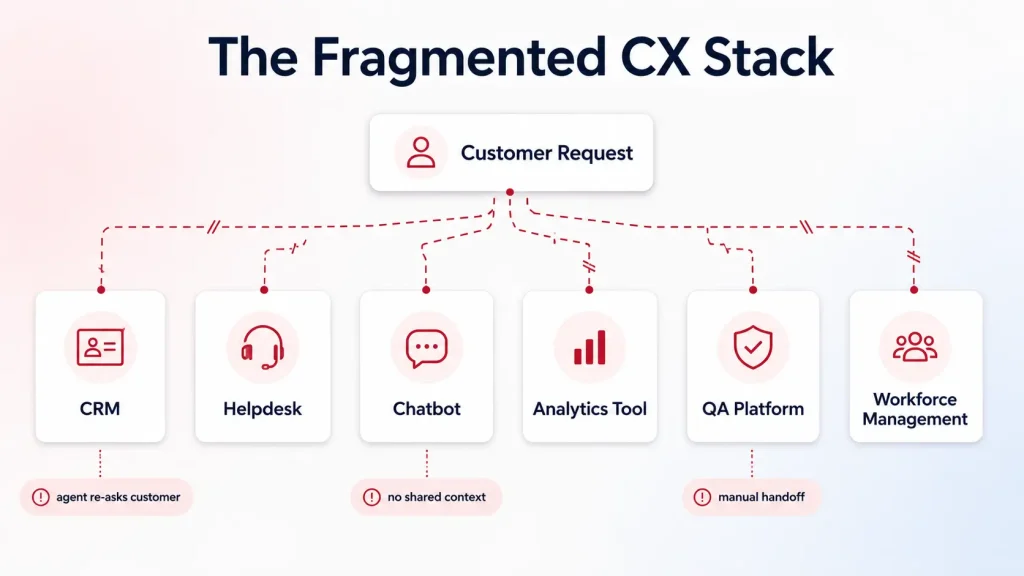
This is the part worth sitting with, because it reframes where the actual failure sits. Salesforce’s most recent research on service leaders found that 44% of those already using AI say tech silos have delayed or limited their AI initiatives, not because the AI underperformed, but because it was deployed on top of data and workflows that were never unified to begin with. An AI agent that cannot see the order status system, the billing platform, and the case history at the same time will guess, escalate unnecessarily, or give an answer that contradicts what another tool already told the customer. The model isn’t the bottleneck. The wiring between systems is.
This is precisely the gap Gartner named in its January 2026 report on agentic AI vendors, warning that enterprise AI will fail to scale without a dedicated orchestration layer. Gartner defines agentic orchestration as the control layer that lets AI move from isolated pilots to governed, autonomous execution, improving speed, lowering cost, and enabling growth that a collection of disconnected point solutions structurally cannot deliver. The report’s core argument is not that enterprises need more AI. It’s that they need something coordinating the AI they already have.
The pattern isn’t limited to CX, which is part of why it’s easy to underestimate. Across enterprise software broadly, the average organization now runs several hundred SaaS applications while actively using under half of the licenses it pays for, a gap large enough that analysts increasingly treat unused software as a line-item cost rather than background noise. CX teams feel a sharper version of the same problem because their tools sit directly in the customer-facing path. When coordination breaks down in a back-office analytics stack, a report runs slow. When it breaks down in a CX stack, a customer notices in real time.
Orchestration is not another tool
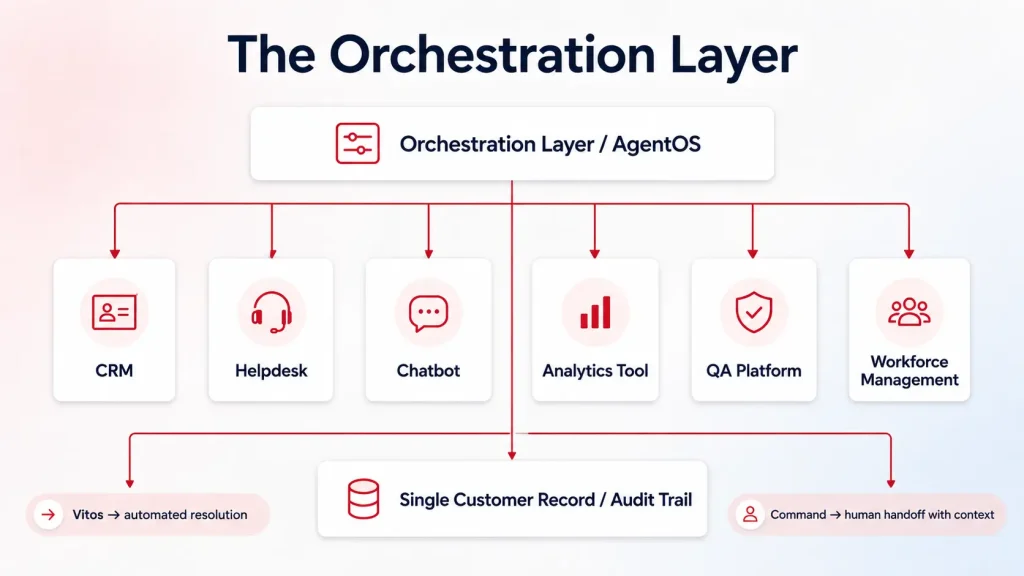
The instinct, when a stack feels unmanageable, is to buy one more platform that promises to “unify everything.” That instinct is usually how the stack got to ten tools in the first place. Orchestration is not a category of tool sitting alongside the CRM and the helpdesk. It’s the layer that sits above them, deciding which system handles which part of a request, passing context between them, and holding a single record of what actually happened, so a handoff between a chatbot and a human agent doesn’t mean the customer repeats their problem from scratch. Gartner’s framing is specific on this point: the value is in unifying design, runtime, and verification, not in adding another interface for agents to check.
The vendor-selection question is changing
For years, evaluating a CX platform meant asking which tool did the best job at one function; the best chatbot, the best ticketing system, the best analytics dashboard. That question is starting to matter less than a different one: who in this stack is actually coordinating the other nine tools, and what happens when two of them disagree about the state of a customer’s account? A platform that answers a question well but cannot see what the billing system already told the customer isn’t a smaller version of the problem. It’s the same problem wearing a better interface.
This also isn’t an argument for ripping out every tool a CX team has bought over the past three years. Most of those tools work fine at the job they were bought for. The point-solution era wasn’t a mistake so much as a predictable outcome of buying reactively, function by function, without anyone owning how the pieces would eventually need to work together. Consolidation, done well, doesn’t mean fewer capabilities. It means one accountable layer deciding how those capabilities get invoked, in what order, and with what shared record of the customer, instead of ten teams independently trusting that the handoffs will somehow just work.
This is the structural bet behind Kapture AgentOS. Rather than adding an eleventh point solution to an already sprawling stack, AgentOS is built as the coordination layer itself, connecting CRM, ticketing, knowledge base, and every deployed AI agent into one system with a shared context and a single audit trail. Vitos handles end-to-end resolution for the high-volume, well-defined requests that make up the bulk of ticket volume. Command governs the handoffs, disputes, and edge cases that need a human, with full context already attached instead of a customer having to explain themselves again. Neither works as well bolted onto a fragmented stack as it does inside a system designed to coordinate one.
Three years of point-solution buying got most enterprises to where they are today: real capability, scattered across ten places, with no single layer accountable for how it fits together. Fixing that doesn’t start with buying tool number eleven. It starts with asking which layer in the stack is actually responsible for coordination, and building or buying toward that answer directly rather than around it. The organizations that get this right over the next year won’t be the ones with the most AI. They’ll be the ones where all of it is finally talking to itself.
Get in touch to see it in production.
Other blogs you’d love to read
Explore the advancements in CX and AI through Kapture.
Your Plan. Your Value. Your Growth.
Your business is different – and the pricing should reflect that.
Let’s build a plan that matches your goals, maximizes ROI, and scales with your success.
 +1833-386-0222 (USA)
 enquiries@kapture.cx