














On May 19, Standard Chartered told investors it would cut roughly 7,800 jobs, 15 percent of its corporate functions workforce, by 2030, framing the reduction as AI replacing what CEO Bill Winters called “lower-value human capital.” Two days later, JPMorgan CEO Jamie Dimon told Bloomberg the bank would likely hire “more AI people and fewer bankers in certain categories.” By July, Ford was moving in the opposite direction, rehiring more than 350 veteran quality engineers, known internally as “gray beards,” after AI-driven inspection systems failed to catch defects that cost the company billions in recalls, an about-face analysts have started calling the AI boomerang.
Three companies, three different conclusions about the same technology, inside the same seven weeks. Only one of the three has already lived through an AI boomerang. The other two are still deciding whether they will.
Standard Chartered’s cuts land in back-office corporate functions: reconciliation, processing, compliance checking, the parts of a 52,000-person division built around volume and repetition. That is precisely the work a rules-based system is good at, and the bank’s own framing treats it that way, calling it a reallocation of capital rather than a productivity claim about the whole bank. JPMorgan’s move is smaller and slower by design. Dimon’s own qualifier, “in certain categories,” is doing real work in that sentence. The bank is leaning on roughly 10 percent annual turnover, 25,000 to 30,000 people a year, to shift its hiring mix without a layoff announcement, because leadership knows some banker roles still involve judgment a rules-based system can’t absorb yet.
Ford is the clearest AI boomerang of the three, the case where that distinction got tested and failed. The company had leaned on AI-driven inspection systems and 900 AI-powered cameras to catch quality issues on the line. What those systems couldn’t do was the judgment call: spotting a defect that didn’t match a known pattern, tracing a failure back to its root cause, deciding whether an edge case was a real problem or noise. Ford’s vice president of vehicle hardware engineering put it plainly: AI is “only as good as the information you use to train it.” The company rehired the people who could supply that judgment, and its quality scores moved fast. Ford ranked top among mainstream brands in J.D. Power’s Initial Quality Study for the first time in 16 years, the same year it also became the most recalled automaker in the country, evidence that both directions of the story are true at once. Ford did not walk back its AI investment. It added more than 100,000 new AI-powered tests. It just stopped asking the system to make the calls only a person could make.
Ford is not an outlier. Robert Half data puts the AI boomerang at scale: 32 percent of US hiring managers say they eliminated a role primarily because of AI and later rehired for the same or a similar position. That is not a story about AI failing. It is a story about companies drawing the line between routine and judgment in the wrong place, and finding out at the cost of a rehire instead of before the layoff.
That is the actual difference between these three cases, and the actual mechanics behind every AI boomerang making headlines this year. It has nothing to do with how aggressively each company is investing in AI. Standard Chartered’s cuts are holding because reconciliation and processing genuinely are routine. JPMorgan’s hedge exists because the bank is willing to say, out loud, that not every banker role is. Ford’s reversal happened because a quality inspection call was never as rule-based as the system built for it assumed. The line between automate and augment was always there. The only variable is whether a company finds it by design or by recall notice.
That is the design question Kapture’s AgentOS is built to answer at the level of a single ticket.
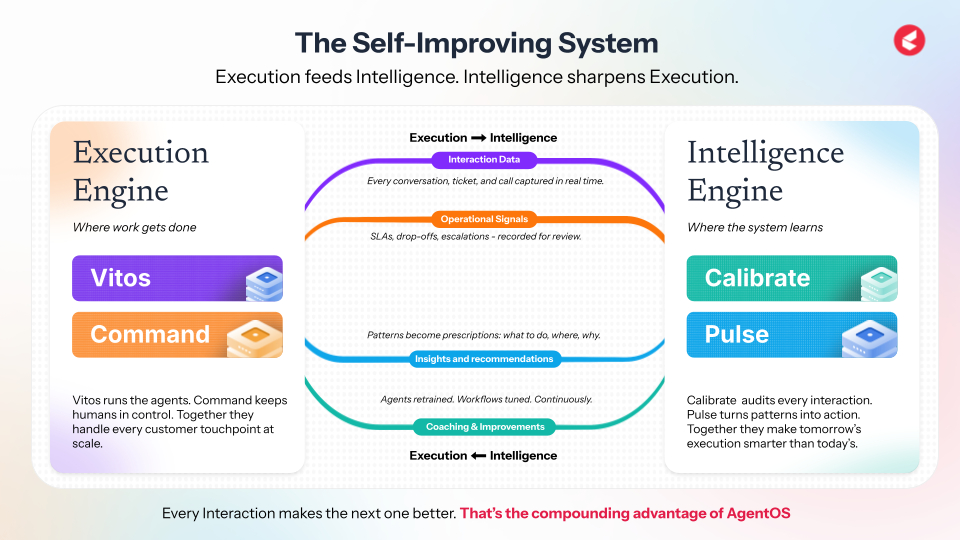
Vitos takes the volume, the queries with a known pattern and a known resolution path. Command routes to a person exactly where a case stops matching that pattern, a dispute, an escalation, a judgment call the system hasn’t seen before. The mistake in most replace-versus-augment decisions is treating automation as one choice applied to a whole function. The workable version of that choice gets made case by case, before the fact, not team by team, after an AI boomerang has already made the decision instead.
This is the line Kapture draws for BFSI and retail enterprises across India today: routine volume to agents, judgment calls to people, in a system that seamlessly talks to its components.
Get in touch to see it in production.
Other blogs you’d love to read
Explore the advancements in CX and AI through Kapture.

Your Plan. Your Value. Your Growth.
Your business is different – and the pricing should reflect that.
Let’s build a plan that matches your goals, maximizes ROI, and scales with your success.
 +1833-386-0222 (USA)
 enquiries@kapture.cx