












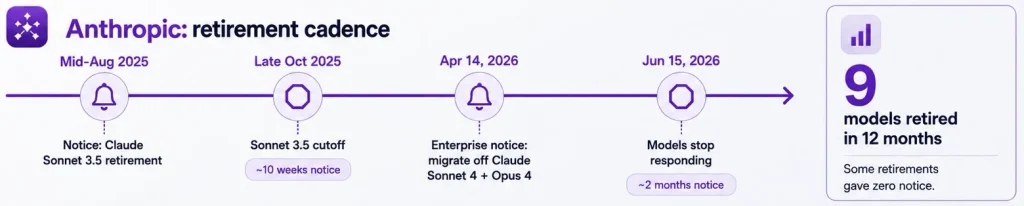
Here’s a fact that should bother more people than it does: on April 14 this year, Anthropic told its enterprise customers they had two months to get off Claude Sonnet 4 and Opus 4 before the models simply stopped responding. June 15 came, and they did. That was the ninth model Anthropic had retired in a year. A few months earlier, Sonnet 3.5 got pulled with a notice that landed in mid-August and a cutoff in late October. Some of these retirements gave companies ten weeks to prepare. At least one gave them none at all.
OpenAI has been running the same race on a different clock. GPT-5 in August 2025. Then 5.1 in November. 5.2 in December. 5.3 in February. 5.4 in March. 5.5 in April. Six major releases in under nine months, and 5.2 itself was gone from ChatGPT by June, reportedly rushed out the door after Gemini 3 Pro embarrassed OpenAI on benchmarks badly enough to trigger an internal “Code Red.” Whatever conversations were still running on 5.2 got auto-migrated to whatever replaced it. Nobody asked.
We don’t think either company is doing anything wrong here, to be clear. This is just what an actual arms race looks like from the inside. Two labs one-upping each other every few weeks, and enterprise production systems sitting directly in the blast radius, whether they signed up for that or not.

“But isn’t the new model just… better?”
It’s a fair pushback. The newer models are better, almost, always. They boast higher benchmarks, sharper reasoning, and lower costs. Anyone claiming older models are objectively superior is likely misinformed or biased.
However, “better on average” rarely means “better for your specific build.” A model can improve globally while regressing on the three niche behaviors your production system relies on—a specific tone, a messy policy interpretation, or a silent formatting quirk. These regressions don’t show up in a vendor’s changelog; they show up as an unexplained spike in customer escalations two weeks later.
Furthermore, these upgrades happen on the vendor’s schedule, not yours. A two-month notice is small comfort when your team is already underwater. For regulated industries, the problem is even more acute: consistency is a requirement. Auditors don’t care if a model got “smarter” on Wednesday; they care why it behaved differently than it did on Monday.
Ultimately, “newer” doesn’t cancel the bill. Re-testing prompts, re-validating edge cases, and auditing fine-tunes demand real engineering hours. When labs ship updates nine times a year, these aren’t one-off costs—they are a permanent, mandatory tax on your business, regardless of whether the new model actually moves your needle.
So enterprises did the obvious thing
According to a recent a16z survey, 81% of large companies now use at least three different AI model families—up from 68% last year. While OpenAI still leads, Anthropic is catching up fast, nearly doubling its enterprise footprint in months. Most tech leaders expect this trend to continue as companies look beyond a single provider.
Nobody’s doing this because it’s fun. Switching a production system off a model you’ve already integrated, tested, and tuned is genuinely painful, and honestly, 65% of enterprises still say they’d rather just stick with whoever they already trust, mostly because the integration work and procurement headaches aren’t worth reopening. Companies are diversifying because relying on a single model has become too risky to ignore.
Here’s the part almost nobody says plainly
Access to a top-tier model isn’t an edge; it’s a commodity. Relying on a single provider is now a liability. The real advantage lies in smart routing—the ability to match every task to the most efficient model and ensure your system stays resilient even if a vendor changes or disappears overnight.
That’s genuinely solvable, and the tooling’s caught up fast. Routing each request to the cheapest model that can actually handle it, instead of defaulting every query to a frontier model, has been shown to cut inference costs by up to 85% while keeping 95% of top-tier quality, mostly because a lot of production traffic never needed the expensive model in the first place. Basically, most budgets aren’t bleeding because of model costs, but because of the “Rerun Crisis”—inefficient workflows and agentic loops that waste model calls without proper caching. In short: deciding which model to use costs nothing, but deciding wrong at scale is expensive.
Despite billions in spend, 80% of enterprise AI projects fail. Companies are simply stacking models instead of building an orchestration layer that prioritizes business outcomes. Without a system to coordinate these moving parts, more models just mean more points of failure, making it nearly impossible to tie AI spend to actual value.
So where does that actually leave things
We’d argue the real question was never “which model is best right now,” because right now no model lasts forever. Two labs have spent the last year proving, in public, that the top spot changes every few weeks. The real question is: if your provider suddenly changed or retired their model, would your customers even notice?
That’s why we built AgentOS. We focus on outcomes, not specific models. Whether it’s resolving a case, tracking context, or maintaining an audit trail, our logic is independent of any one vendor. If a model shifts, your system keeps running exactly as it should.
Model instability is just background noise when your architecture is built on results rather than a vendor’s roadmap. The winners in this space aren’t the ones who guess the right model; they’re the ones who build a system that never needs to guess.
Get in touch to see it in production.
Other blogs you’d love to read
Explore the advancements in CX and AI through Kapture.
Your Plan. Your Value. Your Growth.
Your business is different – and the pricing should reflect that.
Let’s build a plan that matches your goals, maximizes ROI, and scales with your success.
 +1833-386-0222 (USA)
 enquiries@kapture.cx