














Table of Contents

See how Kapture can work for you
Join the 1000+ Enterprises who transformed their CX while reducing support costs.
Request DemoAn agentic OS coordinates fleets of AI agents — building them, connecting them to your systems, keeping humans in control, and learning from every interaction. Here’s what it is, how it differs from agents and automation, and how to think about adopting one.
Key takeaways
- An agentic OS (agentic operating system) is the software layer that runs, coordinates, and governs AI agents. It’s the infrastructure agents work on — not an agent itself.
- It’s the step beyond single agents and copilots: an agent handles one task, an agentic OS runs the whole fleet — routing work, sharing context between agents, and keeping a human in the loop on the calls that need one.
- It matters now because AI can finish multi-step work, not just assist with it — moving AI from a tool people use to a layer that does a share of the work outright.
- Unlike traditional automation, which executes fixed instructions, agents on an agentic OS pursue goals: deciding in context, adapting across steps, and improving as the system runs.
Most enterprises already have AI agents running somewhere — a support bot, a lead-qualifier, something a team stood up in a sprint and never fully operationalized. What they usually lack is a layer coordinating them. That coordinating layer is the agentic OS, and as agents multiply across an organization, it’s quickly becoming core infrastructure rather than a nice-to-have.
1. What is an agentic OS?
An agentic OS (agentic operating system) is the software layer that runs, coordinates, and governs AI agents, the way a computer’s operating system runs applications. An OS handles memory, scheduling, permissions, and input/output so programs can share one machine without stepping on each other. An agentic OS does the equivalent for agents: it routes work to the right one, gives each the memory and tools it needs, enforces what it can and can’t do, and keeps the whole thing monitored and accountable.
The agents are the workers. The agentic OS is everything that lets a roomful of them operate as a single, coherent system — with one twist a normal OS doesn’t have: this one gets better as it runs, because every interaction is data it can learn from.
2. Why it’s a platform shift, not a feature
Most enterprise AI spending today goes toward making people faster: drafting, summarizing, suggesting. That’s genuinely useful, and it’s also the smaller prize. The bigger one is that AI can now finish work rather than assist with it — reason through a multi-step task, pull what it needs from different systems, take the action, and confirm the result.
That moves AI from a tool your staff reaches for into a layer that performs a share of the work outright. It’s a change in how operations are built, not a productivity tweak laid on top of them, and the timeline is short: Gartner projects that 40% of enterprise applications will include task-specific AI agents by 2026, up from under 5% in 2025. The companies that fall behind will be the ones that treated this as a feature to bolt on instead of a foundation to build on.
3. Agentic OS vs. AI agents, copilots, and automation
The label gets stuck on a lot of different things, so it’s worth pinning down where it sits.
A single AI agent is one unit of autonomy — usually a language model that can plan, call tools, and act toward a goal. Agentic AI is the umbrella term for software that behaves that way: pursuing outcomes instead of waiting for the next instruction. An agentic OS is the layer above both — the thing that runs many agents together and governs how they behave.
The cleanest way to keep them straight: a chatbot handles a conversation, an agent handles a task, and an agentic OS handles a whole workflow — routing work across several agents, carrying context between them, wiring into your real systems, and returning a completed result rather than a recommendation someone still has to act on.
It’s also a different species from the automation you already run:
| Traditional automation | Agentic OS | |
|---|---|---|
| Trigger | Fires on a fixed event or manual input | Agents act continuously toward a goal |
| Decision-making | Pre-set rules and flows | Decides in context, step by step |
| Adaptability | Breaks when the process changes | Adjusts and reroutes on the fly |
| Error handling | Needs manual recovery | Self-corrects and retries |
| Scope | A single task or step | Whole workflows across multiple agents |
The dividing line is simple: older automation executes instructions, while agents on an agentic OS pursue goals — choosing their steps in context, adjusting when something’s off, and recovering from their own errors.
4. The bottleneck it removes: work that waits
Here’s the inefficiency hiding in most operations. Work doesn’t move on its own — it moves when a person picks it up. A request lands, waits until someone is free, gets actioned, then waits again before the next step. None of that waiting shows up as a line on a dashboard, but it compounds. Forrester estimates companies lose roughly $1.3 million per 100 employees a year to work stalled in queues.
For a long time that was an acceptable cost, because humans were the fastest option and the volumes were survivable. Neither holds now. A large operation can take in hundreds of thousands of requests a month, and AI is generating new work faster than human teams can clear it. The queue, not the work itself, is the constraint — and removing the queue is precisely what an agentic OS is built to do.
5. From a queue of tickets to a team of agents
Picture a routine request: a customer wants to return an item and get refunded. In a queue-based setup, it waits for an agent who opens the order, checks the return policy, confirms the item is eligible, triggers the refund, and emails the customer — often spread across more than one shift. The task isn’t difficult. It’s just sequential and gated on a human being available.
On an agentic OS, the same request resolves in a single exchange, and not because one all-knowing model does everything. Several narrow agents divide the job: one holds the conversation, one reads the order and return history, one checks the request against policy before any money moves. Each is good at a single thing; together they produce an outcome that used to mean a person hopping between four systems.
People stay in the loop where it counts. The system escalates on defined triggers — a frustrated customer, a suspected fraud pattern, anything that calls for judgment — and hands the human the full thread, the data, and whatever has already been done, so no one starts over and the customer isn’t asked to repeat themselves. Every interaction, automated or human, is reviewed rather than spot-checked, so the record is complete and the approaches that work quietly become the default. Run that pattern across collections, claims, onboarding, billing, and IT requests — anywhere work is high in volume and follows a knowable path — and the share of the workload it can absorb is usually larger than the org chart suggests.
6. What an agentic OS has to handle under the hood
Brand names aside, a credible agentic OS has to do four things, and do them in one connected system so context and learning aren’t lost between them:
- Build and run agents. Spin up, test, and deploy agents for any channel and workflow, grounded in your data and rules, with orchestration so several can run in sequence or in parallel.
- Keep people in control. Live visibility into what agents are doing, clean escalation to the right person with full context, and the option to step into a conversation and take over.
- Check every interaction. Continuous quality and compliance review of everything — not a 5% sample — with weak spots flagged and strong performance turned into training.
- Turn activity into improvement. An intelligence layer that explains why outcomes happen, recommends changes, and routes them back into how agents are configured.
Underneath those sit the parts nobody puts in a demo but everything depends on: persistent memory, so an agent recognizes a returning customer instead of starting blank; an integration layer that connects to your CRM, order, and ERP systems through standard connectors rather than one-off builds; and scoped permissions, so each agent can only reach what it’s cleared for. Leave one out and you have an impressive prototype that won’t survive production.
7. Agent work vs. human work: the line that matters
Adopting this well comes down to one decision, repeated across every function: which work goes to agents and which stays with people.
Agent work is the high-volume, context-driven, follows-a-known-path category — answering policy questions, qualifying leads, updating records, processing claims. Human work is the judgment category — the tense conversation, the ambiguous contract, the decision with real stakes. The aim isn’t to shrink the human side. It’s that once routine execution moves to agents, the work that actually reaches your team is the work that genuinely needs a person.
Most organizations have never drawn this line on purpose, and AI is now blurring it for them by default. Drawing it deliberately, function by function, is the part that’s actually strategy.
8. Why a platform beats a pile of tools
The tempting path is to buy a point tool for each problem — one for support, one for sales, an analytics layer on top. The catch is that they don’t talk to each other: no shared context, no shared memory, no shared learning. Each new tool is another integration to maintain and another place where what the system knows resets to zero, and you end up with a more expensive, more fragile version of the setup you already had.
A single foundation is the opposite bet. The more functions that run on it, the more context they share — and because the foundation learns, every function on it gets sharper over time instead of staying frozen at launch. That’s the difference between assembling a toolkit and building something that compounds.
9. Kapture AgentOS
Kapture AgentOS is one implementation of all of this. Kapture has spent a decade running inside enterprise operations — retail, financial services, travel, energy, digital-native businesses — rather than building for them at arm’s length. Its agents now handle more than 3 million interactions a day for over 1,000 organizations, among them Coca-Cola, Walmart, Reliance, Unilever, and Tata, across 18 countries. The edge cases that tend to break AI platforms after launch — the exceptions, the compliance gray areas, the call on whether to act or escalate — are the conditions it was designed around.
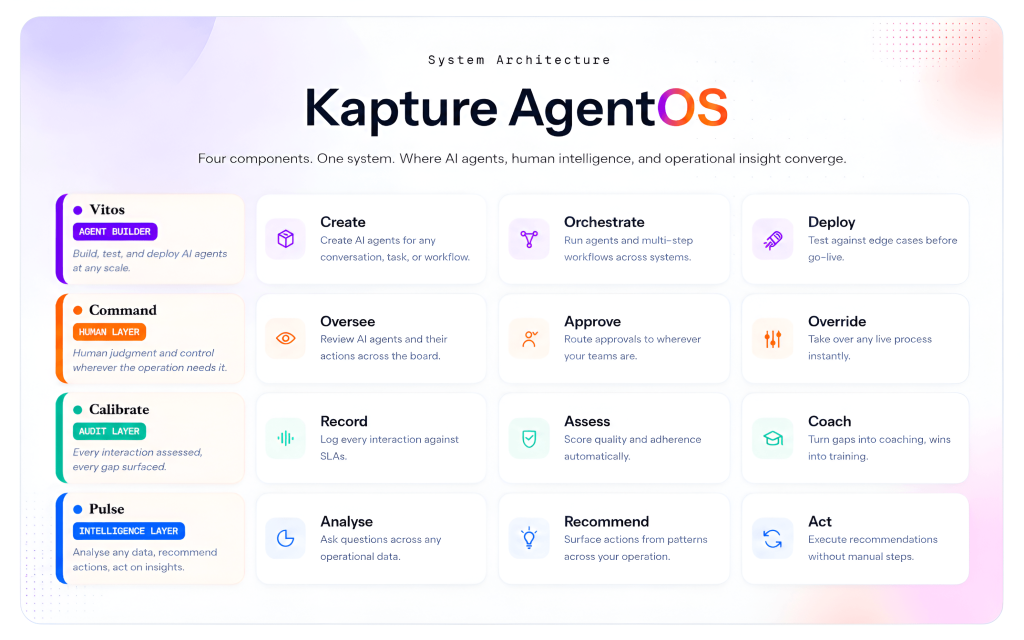
Its four layers line up with the four jobs above. Vitos is where agents get built, tested, and deployed. Command is the human layer: oversight, escalation, and the ability to take over a live conversation. Calibrate is the quality-and-compliance layer that reviews every interaction and turns gaps into coaching. Pulse is the intelligence layer that reads any data source — including your own tables, not just Kapture’s — surfaces the next best action, and feeds it back into the system. The first two get the work done; the second two make the next round of work sharper.
10. How to start
If you’re weighing this, two moves matter more than choosing a vendor. First, look hard at your highest-volume functions and separate the routine from the genuine exceptions; that routine, knowable-path share is your opening for agents, and it tends to be bigger than it looks from the outside. Second, decide whether you’re buying tools or building a foundation. Tools are quicker to adopt and slower to compound; a foundation is the reverse. Given how early the category still is, the real leverage is in starting that foundation now, while the boundary between agent work and human work is still yours to draw.
FAQ
- It’s the operating layer for AI agents — the system that builds them, routes work between them and human staff, keeps everything compliant and reviewed, and learns from each interaction. The agents do the work; the agentic OS runs the agents.
- A chatbot answers one conversation and a copilot assists a person inside one task. An agentic OS executes entire workflows across several coordinated agents and brings in a human only for the cases that genuinely need judgment.
- No. AGI refers to AI with broad, human-level general intelligence. An agentic OS is narrower and practical: it coordinates task-specific agents within defined boundaries, under human oversight, to get real work done. It doesn’t need general intelligence to be useful — it needs reliability, context, and clear limits.
- No — it changes what they spend their time on. Routine, high-volume work shifts to agents, and people are freed for the judgment-heavy cases where a human changes the outcome, arriving with the full case already assembled instead of starting cold.
- A real agentic OS connects to your CRM, order management, ERP, and support stack through standard integrations — and the stronger platforms let you bring your own data, and even your own model, rather than locking you in.
- With a high-volume function full of repetitive, knowable-path work — customer support, claims, collections, billing — where the cost of work sitting in a queue is highest.
The takeaway
The center of gravity in enterprise AI is shifting from the individual agent to the system that runs the agents. That system — the agentic OS — is what lets autonomous software do real work without becoming a liability, and what lets it improve the longer it runs. The shift is already underway across operations. For most leaders the question isn’t whether it happens, but whether they shape it deliberately or live with whatever it turns into on its own.
Other blogs you’d love to read
Explore the advancements in CX and AI through Kapture.
Your Plan. Your Value. Your Growth.
Your business is different – and the pricing should reflect that.
Let’s build a plan that matches your goals, maximizes ROI, and scales with your success.
 +1(415) 319-8777 (USA)
 enquiries@kapture.cx