

Are your agents drowning in hidden tasks that never make it onto the radar? While CX improvements focus on visible interactions, there is a quiet force undermining these efforts.
That’s shadow work: repetitive, non-ticket tasks like updating spreadsheets or manual follow-ups. It is unrecognized, unmeasured, and quietly gobbles up 20-40% of agent time.
The real challenge? These tasks are not tracked, which makes them a silent bottleneck in your customer experience. But here’s the good news: AI can automate shadow work to free up agents’ valuable bandwidth. Whether it’s automated transcription or intelligent data entry, AI enhances operational workflow with laser-focused accuracy and speed.
This blog explores how AI can help you scale efficiency by eliminating shadow work in your contact center.
What Shadow Work Looks Like in Real Contact Centers
Shadow work refers to the unaccounted tasks that agents perform behind the scenes, but often go unnoticed. Usually, these tasks consist of –
1. Multi-System Lookups
Agents have to move through different platforms, like ticketing systems or knowledge bases, in order to build a full customer profile.
For instance, a support agent dealing with a question about a bill may have to check the billing software, the CRM for history, and the knowledge base for the support process. This context-switching fragments focus and increases the average call handling time.
2. Updating CRM with Call Details
Post-call, agents are tasked with logging every interaction nuance –
- What the customer requested
- What issues did the customer face
- What steps did the agent take for resolution
This manual entry often duplicates information from internal notes or other systems. For instance, if an agent resolves a technical issue, they might need to update the CRM with troubleshooting steps.
3. Form-Filling
Internal compliance or QA processes require agents to fill out multiple forms. Each form may have fields that overlap with previous inputs.
For example, filling out a compliance form might involve re-entering customer details already captured during the call. This redundant task drains time and increases the potential for data entry errors.
4. Internal Approvals
Refunds and escalations are two examples of actions that call for multi-layered approval systems. An agent might initiate an approval request through an internal portal, waiting for managers to review and authorize. This may lead to delays and operational throughput.
5. Tagging Calls with Reason Codes
To facilitate analytics, agents assign reason codes to categorize interactions like “billing issue” or “technical fault”. However, selecting the correct code relies heavily on context and agent judgment.
For example, misclassifying a complaint as a “technical issue” rather than “service dissatisfaction” can skew data insights.
6. Logging Dispositions
After the call, agents classify the outcome –
- Resolved
- Follow-up needed
- Escalated
These classifications are often subject to subjective interpretation or rushed entries. It can distort performance metrics and obscure service bottlenecks.
7. After-Call Wrap-Ups
Agents take extra time to complete post-call documentation and send follow-up emails. This adds up to a large amount of agent bandwidth, causing burnout.
The Hidden Cost of CX & Agents
The time spent on shadow work varies across industries and call complexity. Though invisible, it may incur high costs, like longer training cycles and higher attrition.
Here is how piled-up shadow work directly affects CX and agents!
1. Inflates Average Handle Time (AHT)
As agents are required to perform these tasks actively while on the call or immediately afterward, the total time spent per customer interaction increases. This extension directly raises the measured AHT since
AHT = talk time + hold time + after-call work
Thereby, it also limits the number of calls an agent handles.
2. Slows Down Resolution
An agent puts the call on hold to find relevant information in a different system, then goes back to the customer. This may lead to repeated questions and increased resolution times.
3. Causes Inconsistency and Compliance Risks
Non-compliance in contact centers may incur huge fines. According to Cyber Defense Magazine, organizations that disregard data protection laws often incur costs of $14.82 million.
When agents are weighed down with extra manual tasks, there is a higher possibility of errors or overlooked details. This discrepancy can put compliance standards at risk and affect service quality.
4. Drives Burnout and Churn
Agents get more stressed when they have to routinely manage shadow work. This strain eventually leads to burnout, which affects operational stability and raises turnover rates.
According to Contact Centre Briefing Magazine, 46% of agents say they have no control over their schedules, which could lead to burnout and disengagement.
Tasks Ripe for Automation
Shadow work is silently draining both agents and CX, but here’s the solution: AI-powered automation can easily eliminate these burdens.
AI agents trained in NLP can interpret and generate human-like summaries, fetch relevant data, and even verify information, all in real time.
Similarly, human agents can concentrate on high-value interactions while RPA handles mundane backend upgrades and data entry. Instead of just automating tasks, these smart agents work together as a coherent system. They exchange context and feedback to orchestrate outcomes.
Contact centers can transform from transactional hubs to strategic ecosystems by using these technologies. While AI is there to perform monotonous tasks at a faster rate, human agents, on the other hand, can provide real empathy and judgment to solve customer issues.
Impact of Automating Shadow Work
Building on the prime tasks identified for automation, it’s clear that shadow work would benefit immensely from it. Contact centers can tap into a range of transformative benefits, like –
- Cut Processing Time by 20–40% – Usually, shadow work takes up a large chunk of agent time after calls. With AI handling these chores, processing times drop. Results? Faster case closures and serving more customers.
- Higher FCR, CSAT, and Fewer Errors – AI helps ensure that after-call customer records are precise and up-to-date. This, in turn, boosts customer satisfaction and resolution rates. The agents dedicate less time to fixing manual mistakes and more time to focus on the customer’s needs.
- Streamlines Onboarding – AI takes care of many routine tasks involved in onboarding new agents, like training and documentation updates. This eases the onboarding process and minimizes the learning curve.
- Reduces Cognitive Load – By automating tiresome shadow work, AI lessens the mental strain on agents. It helps them perform at their best without being bogged down by monotonous tasks.
How Kapture Fastlane Automates These Tasks
Kapture Fastlane is an internal Robotic Process Automation (RPA) product. That means it automates repetitive procedures within the CX platform to improve efficiency and lower manual latency.
Here is how it works to eliminate shadow work –
1. One-Click Execution of Multi-Step Workflows
Suppose you have a lengthy after-call process that involves several steps. Instead of doing each step manually, Kapture Fastlane lets you set up these workflows once and then run them with just a single click.
You just activate the workflow, and Fastlane takes care of the rest with consistency and speed.
2. Automates Lookups and Updates
Fastlane isn’t just about automation; it’s about smart automation. Need to look up customer info from a database? Validate some data before proceeding? Fastlane handles all of this automatically. It can –
- Perform lookups to fetch the right data
- Validate inputs to ensure accuracy
- Submit forms on your behalf
- Update records across your systems
This means your agents spend less time on repetitive tasks and more on solving complex issues.
3. Suggests Flows Contextually
Fastlane understands the context of a custom query. Based on the current support case, it suggests the most relevant workflows or actions.
4. Lives Under AI Agents for Support Teams
All these capabilities are integrated within Kapture’s AI Agents platform. This means Fastlane doesn’t work in isolation; it’s part of a broader AI-powered support ecosystem. It’s designed to empower support teams with automation and intelligence.
How to Identify Which Shadow Tasks to Automate First
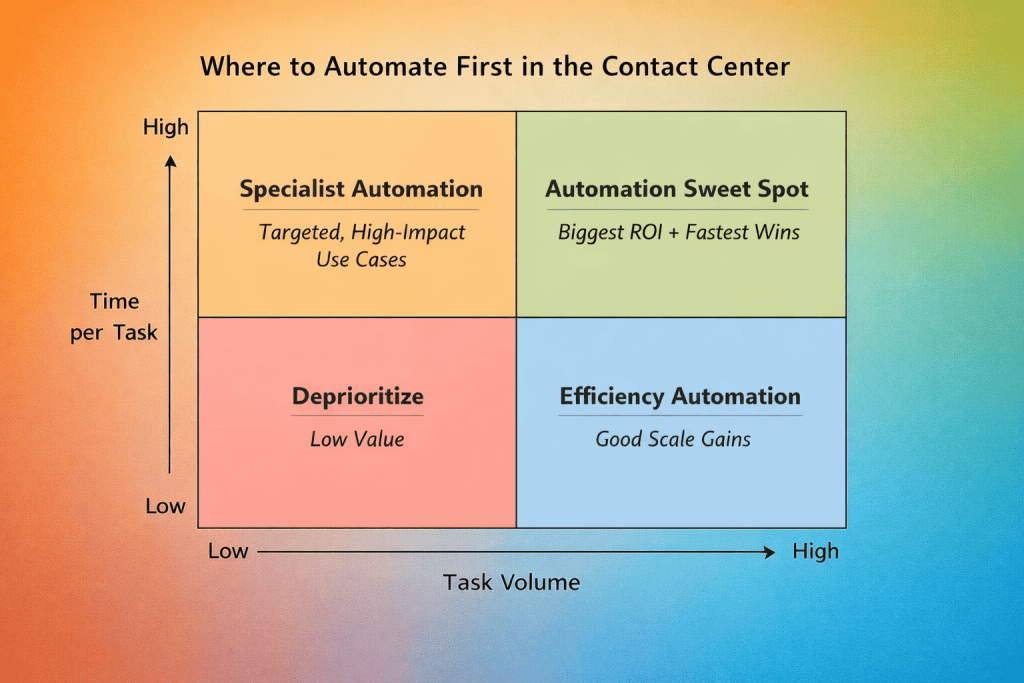
Now that you know how automating shadow work can boost efficiency, the next move is to decide where to begin. Here’s a simple approach –
- Track and List Post-Call Activities – The first step is to take note of the activities that agents perform after calls.
- Pinpoint Time-Consuming Tasks – Discover the activities that take up most of the agent’s time. Tasks that lower their productivity are the best choices for automation.
- Assess Frequency and Volume – Give a higher priority to those tasks that occur frequently and have a large number of cases. Automation of high-volume tasks results in the most significant overall time savings.
- Factor in Ease of Automation – Some tasks are, from a technical point of view, easier to automate than others. Begin with those that need simple data entry or repetitive checking for quick wins.
Here is a quick sample chart to help you identify shadow tasks and prioritize for automation.
| Measure Volume of tasks + Time taken | Priority Level |
| High volume + High time | Prime for automation |
| Low volume + High time | Riper for automation |
| High volume + Low time | Relatively ripe for automation |
| Low volume + Low time | Low value/ ignore |
Turn Invisible Load to Faster CX!
If your agents take minutes to manually wrap up each call, you are throwing away more than just time. Your ability, competitiveness, and compliance assurance are all declining.
However, shadow work is no longer unavoidable. AI automation provides a quicker, more intelligent substitute for manual wrap-up tasks. Whether it’s smart categorization or automated summaries, AI takes over shadow work without compromising on compliance.
Is shadow work silently leaking your revenue bucket? Kapture CX is here to help. Our Fastlane toolkit turns complex, multi-step processes into simple, one-click actions. It focuses on making support faster, smarter, and more reliable, while cutting down on the invisible load on agents.
Wish to drive operational efficiency? See how Kapture’s Fastlane works to automate shadow work!
FAQs
AI systems are equipped with validation mechanisms and compliance protocols that automatically check data accuracy and adhere to industry regulations.
No, modern AI tools are curated for compatibility with current systems. You can opt for a phased approach and start with high-impact tasks. This ensures seamless implementation and quick ROI.
Challenges include integration complexity and employee resistance. These can be solved through thorough planning and staff training.