
Retrieval-Augmented Generation (RAG) in Enterprise CX

Retrieval-Augmented Generation (RAG) in Enterprise CX

Table of Contents

Request a demo

See how Kapture can work for you

Join the 1000+ Enterprises who transformed their CX while reducing support costs.

Request Demo

Abstract

The rapid adoption of Large Language Models (LLMs) has redefined enterprise AI, particularly within customer experience (CX). However, organizations deploying standalone generative systems are encountering systemic limitations: inconsistent accuracy, lack of real-time awareness, and minimal alignment with proprietary enterprise data.

Retrieval-Augmented Generation (RAG) emerges as a foundational architecture to address these constraints. By combining retrieval systems with generative models, RAG enables AI systems to ground outputs in enterprise-specific, real-time data, significantly improving factual accuracy and operational reliability.

This paper examines the architectural principles, performance implications, and enterprise deployment considerations of RAG, with a focus on Kapture’s implementation for CX environments.


1. The Enterprise AI Gap

Despite advances in generative AI, enterprises face a structural disconnect between model intelligence and organizational knowledge. Most LLMs operate as probabilistic systems trained on static datasets, whereas enterprise environments are dynamic, fragmented, and deeply contextual.

This gap manifests in three critical ways. First, responses lack determinism when domain-specific knowledge is required. Second, models fail to incorporate recent or transactional data. Third, outputs are often non-actionable, limiting AI to advisory roles rather than execution.

RAG addresses this gap by introducing a retrieval layer that acts as a bridge between enterprise data systems and generative reasoning.


2. RAG as a System Architecture

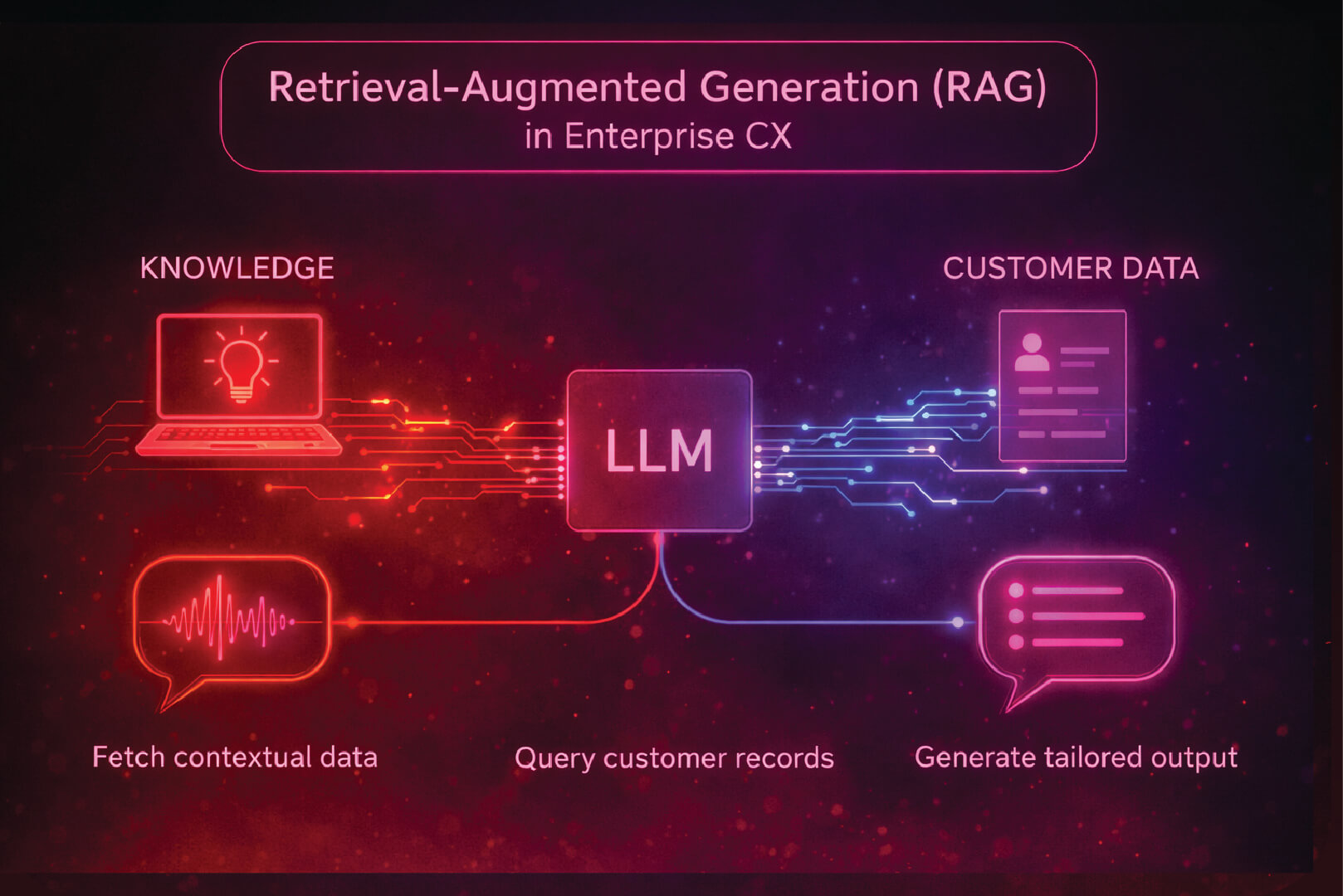
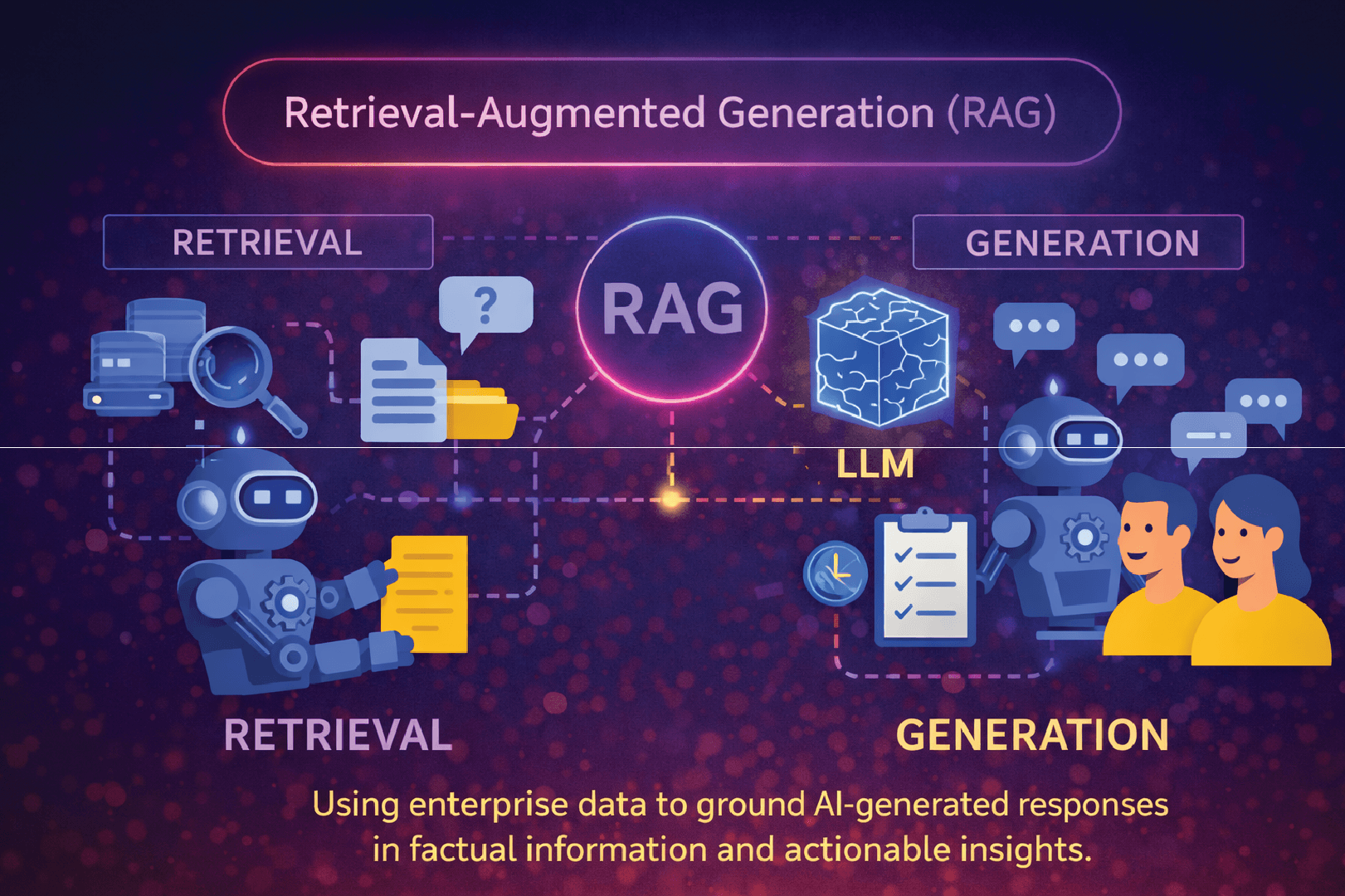
At its core, RAG is not a feature but a distributed system design pattern. It redefines the AI pipeline into two tightly coupled stages: retrieval and generation.

2.1 High-Level Architecture
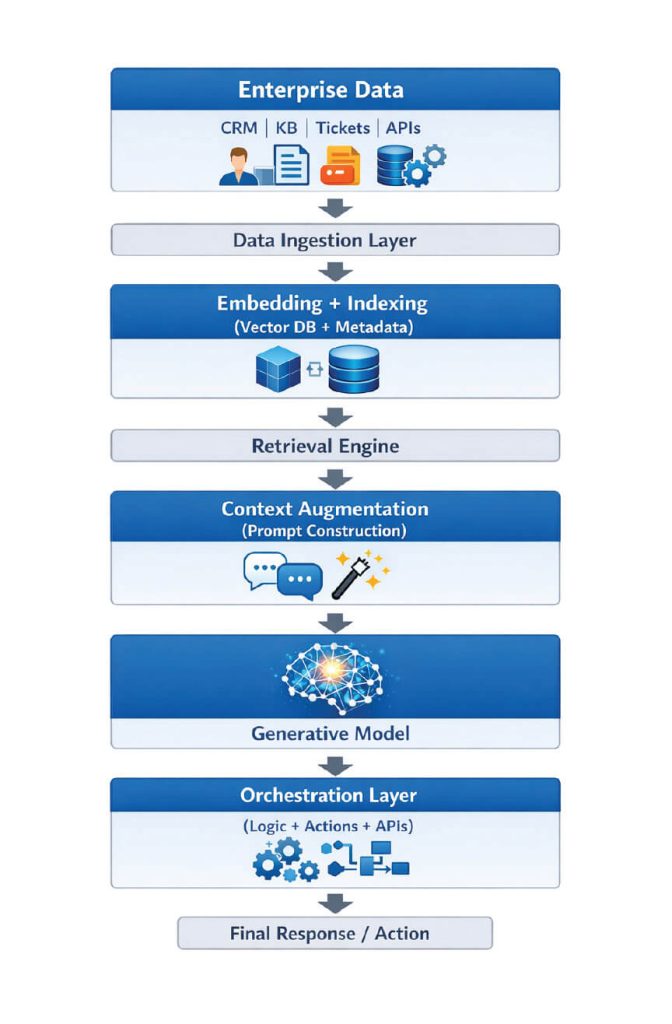
This architecture enables the system to dynamically retrieve relevant information, inject it into the model context, and generate outputs that are both linguistically coherent and factually grounded.


3. Kapture’s Enterprise RAG Stack

Kapture operationalizes RAG as a multi-layered system optimized for CX workflows, where latency, accuracy, and actionability are equally critical.

3.1 Knowledge Unification Layer

Rather than treating data sources independently, Kapture constructs a unified knowledge fabric. This layer normalizes structured and unstructured data into a consistent representation, enabling seamless retrieval across systems.

3.2 Hybrid Retrieval Architecture

Kapture employs a hybrid retrieval strategy combining semantic vector search with deterministic keyword filtering. This dual approach improves recall for ambiguous queries while maintaining precision for structured queries.

3.3 Context Engineering

A key differentiator lies in how context is constructed. Instead of naïvely appending retrieved documents, Kapture applies relevance scoring, redundancy elimination, and token optimization. This ensures that only high-signal data is passed to the model.

3.4 Action-Oriented Orchestration

Unlike traditional RAG pipelines, Kapture integrates an orchestration layer capable of executing workflows. This transforms the system from a passive responder into an active problem resolver.


4. Execution Flow in Kapture RAG
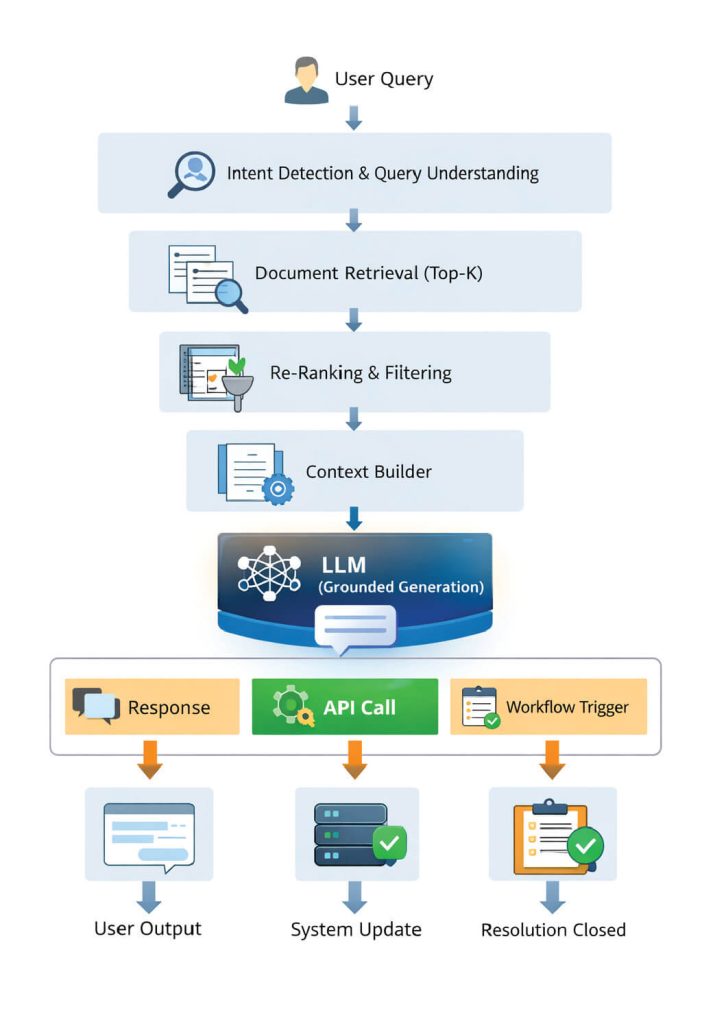
This flow illustrates how RAG transitions from information retrieval to full-cycle resolution.


5. Performance Metrics and Benchmarks

In enterprise deployments, the effectiveness of RAG systems is measured across multiple dimensions. Based on internal benchmarks and industry-aligned evaluations, the following improvements are typically observed when transitioning from standalone LLMs to RAG-based systems:

Accuracy (factual correctness) improves from approximately 70–75% to 90–95%, depending on data quality and retrieval precision.

Hallucination rates decrease significantly, often by 60–80%, as responses are grounded in verifiable sources.

First Response Time (FRT) in CX environments can be reduced by 30–50%, driven by instant retrieval and automated resolution.

Ticket deflection rates increase by 25–40%, as more queries are resolved without human intervention.

Operational cost reductions typically range between 20–35%, particularly in high-volume support environments.

Latency, often perceived as a trade-off, can be optimized to sub-second retrieval and 1–2 second end-to-end response times with efficient indexing and caching strategies.


6. Evaluation Framework

Evaluating RAG systems requires a shift from traditional NLP metrics to more holistic, system-level KPIs.

Retrieval quality is measured using metrics such as Recall@K and Mean Reciprocal Rank (MRR). Generation quality is evaluated through relevance, coherence, and groundedness. However, the most critical metric in CX environments is resolution success rate, which captures whether the AI system successfully completes the user’s intent.

A mature evaluation framework integrates offline benchmarking with real-time feedback loops, enabling continuous optimization.


7. Pseudo-Code: RAG Pipeline

Below is a simplified representation of a RAG pipeline as implemented in enterprise systems:

def rag_pipeline(user_query):

# Step 1: Understand query
intent = detect_intent(user_query)

# Step 2: Retrieve relevant documents
documents = retrieve_top_k(
query=user_query,
k=5,
method="hybrid_search"
)

# Step 3: Re-rank documents
ranked_docs = rerank(documents, user_query)

# Step 4: Build context
context = build_context(ranked_docs, token_limit=2000)

# Step 5: Generate response
response = llm.generate(
prompt=create_prompt(user_query, context)
)

# Step 6: Decide action
if requires_action(intent):
action_result = execute_workflow(intent, context)
return action_result

return response

This abstraction highlights the modular nature of RAG systems and their extensibility in enterprise environments.


8. Design Considerations

Implementing RAG at scale requires careful attention to system design. Data quality remains the most critical dependency; poor or outdated data will directly degrade system performance. Latency must be managed through efficient indexing, caching, and query optimization. Security considerations include role-based access control and data isolation, particularly when dealing with sensitive enterprise information.

Equally important is context management. Overloading the model with excessive or irrelevant context can reduce accuracy, making context engineering a key discipline within RAG implementations.


9. Strategic Implications for CX Leaders

RAG fundamentally shifts the role of AI in CX from automation to augmentation and ultimately to autonomy. Organizations adopting RAG are not merely improving response quality; they are redefining how knowledge is accessed and operationalized.

This has three strategic implications. First, knowledge management becomes a core AI competency rather than a support function. Second, AI systems evolve into execution engines capable of resolving customer issues end-to-end. Third, competitive differentiation increasingly depends on how effectively organizations leverage proprietary data within AI systems.


10. Conclusion

Retrieval-Augmented Generation represents a critical evolution in enterprise AI architecture. By grounding generative models in real-time, enterprise-specific data, RAG addresses the fundamental limitations of standalone LLMs.

Kapture extends this paradigm by integrating retrieval, reasoning, and execution into a unified system designed for CX. The result is not simply better responses, but measurable business outcomes: higher accuracy, faster resolution, and lower operational cost.

As enterprises move toward agentic AI systems, RAG will serve as the foundational layer enabling trust, scalability, and sustained competitive advantage.

Your Plan. Your Value. Your Growth.

Your business is different – and the pricing should reflect that.
Let’s build a plan that matches your goals, maximizes ROI, and scales with your success.
Get Demo

Model Context Protocol (MCP): the missing interoperability layer for autonomous AI workflows

Model Context Protocol (MCP): the missing interoperability layer for autonomous AI workflows

Table of Contents

Request a demo

See how Kapture can work for you

Join the 1000+ Enterprises who transformed their CX while reducing support costs.

Request Demo

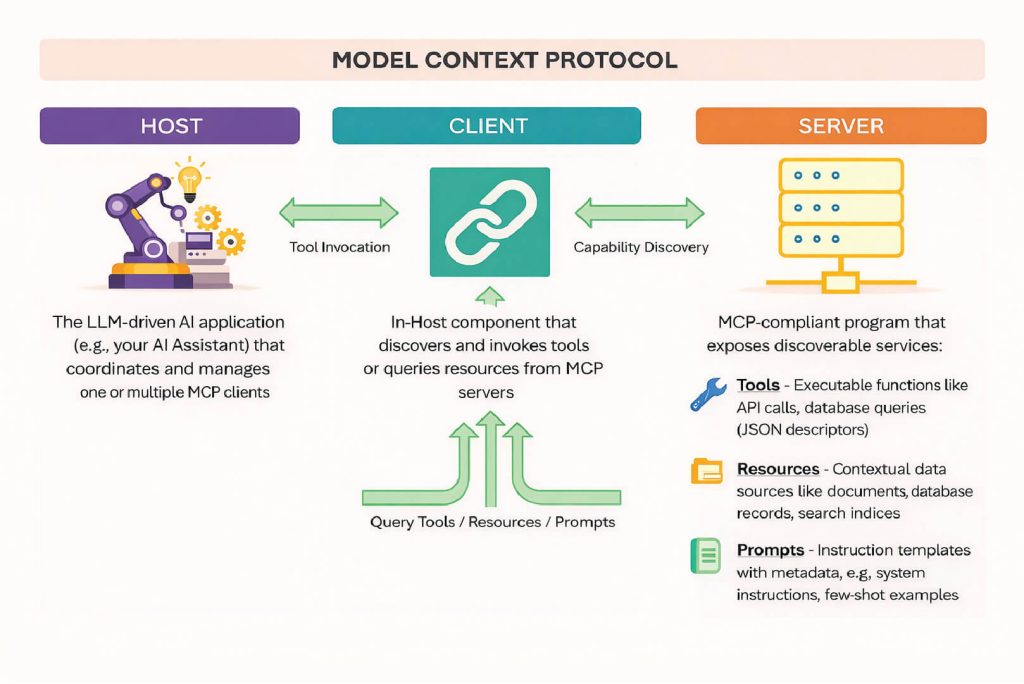
Model Context Protocol (MCP) is an open interchange standard that standardizes how LLM-powered agents discover capabilities, fetch contextual data, and invoke actions across systems. Think of MCP as a universal connector –   a common runtime contract that lets agents treat external tools, data stores, and instruction templates as first-class, discoverable resources instead of brittle prompt snippets.

The integration problem

Before protocolized context, integrating an agent with external services was manual and fragile:

  • Agents could be instructed to call an API, but each agent needed bespoke guidance on that API’s auth, parameters, and error semantics.
  • Tool knowledge lived in prompts or orchestration glue, so tools weren’t reusable across agents.
  • Builders using orchestration platforms like n8n or LangGraph had to re-encode tool behavior per agent, producing non-modular, hard-to-test flows.

The result: integrations were one-offs, plans were brittle, and agents could not reliably compose or hand off work to each other.

What MCP is (concise definition)

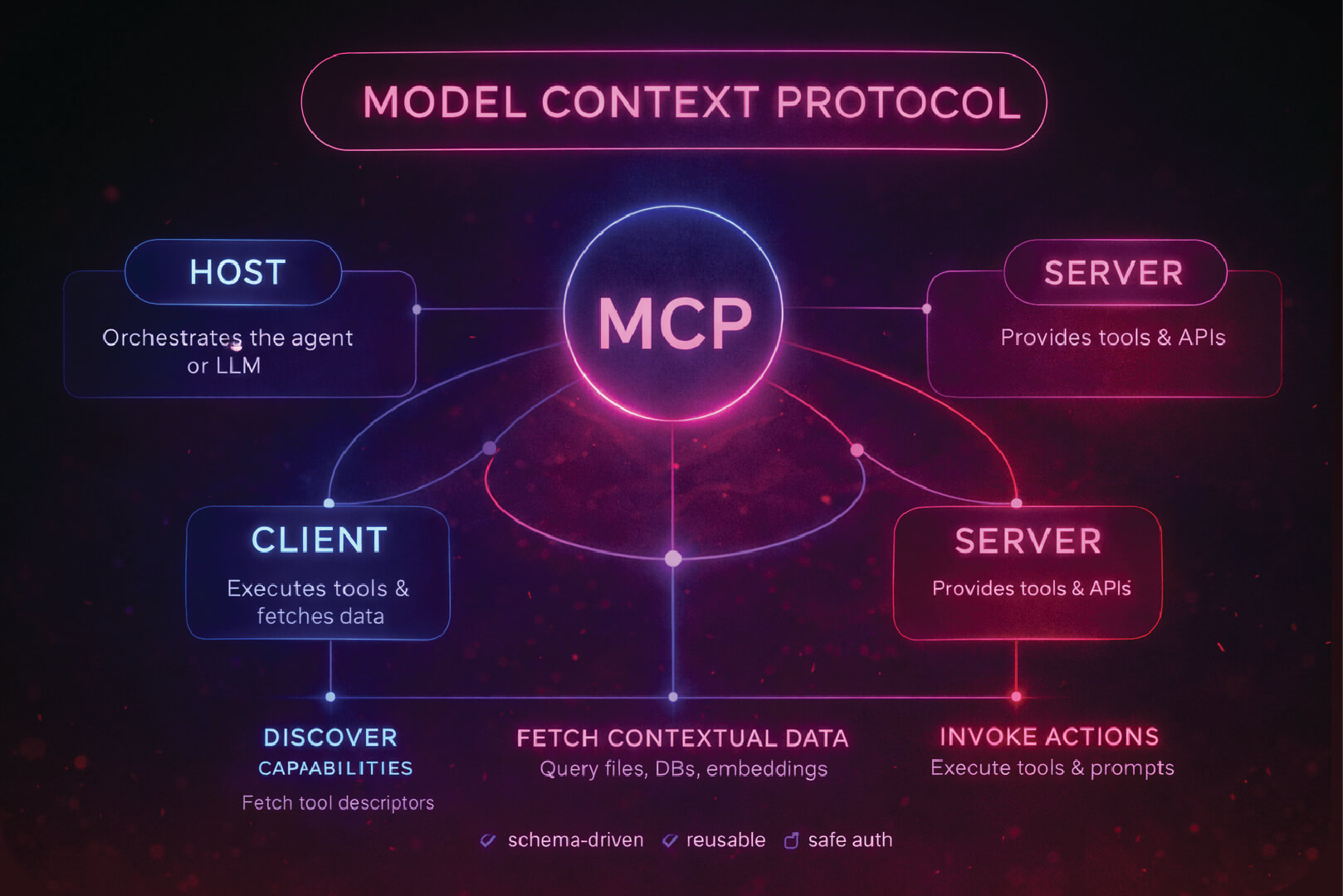
MCP defines a machine-readable, schema-driven contract for three roles:

  • Host — the LLM application orchestrating one or more MCP clients (the runtime that runs planner/agent loops).
  • Client — an in-process component inside the Host that consumes server-provided descriptors (tools, resources, prompts) and executes them under the agent’s control.
  • Server — the authoritative provider of capabilities and context: a registry of executable tools, indexed resources (files, DB rows, search), and canonical prompt templates.

MCP standardizes metadata for each capability: auth requirements, input/output schemas, usage examples, and runtime hints. That lets clients perform discovery and invoke tools without ad-hoc prompt engineering.

(The MCP specification and exemplar server implementations are documented on the official MCP site.) modelcontextprotocol.io

Core building blocks (what the protocol exposes)

  1. Tool descriptors — machine-readable definitions that include: name, purpose, I/O schema, sample calls, error semantics, required scopes/credentials, and idempotency notes.
  2. Resource APIs — standardized endpoints to fetch contextual data (documents, search results, DB snippets, cached embeddings) with provenance and freshness metadata.
  3. Prompt schema — structured instruction templates that pair task intent, role framing, and tool hints so models receive consistent grounding across Hosts.
  4. Execution & telemetry — a canonical log of tool invocations, responses, and artifacts to enable replay, auditing, and human review.

What MCP enables (practical capabilities)

  • Discoverable tooling: agents can query “what can I call?” and receive rich metadata (auth, example payloads, input schema).
  • Safe composition: a planner can synthesize multi-step plans that call heterogeneous tools (search → transform → persist) with validated schemas.
  • Shared memory and context: Servers surface summaries, embeddings, and prior outputs so agents reason over the same history.
  • Pluggable auth: MCP specifies how credential material is surfaced to the Host (token scopes, ephemeral credentials), reducing secret-leakage risks.
  • Reusability: once a tool is described by an MCP server, any MCP-aware agent can integrate it without per-agent prompt surgery.

Concrete scenario: a GTM summary agent

Imagine a product team wants a weekly GTM briefing that aggregates Notes in Notion and tasks in Asana:

  • Without MCP: the agent must be hand-taught each API’s endpoints, auth, and data model; tool logic is embedded in prompts or host glue.
  • With MCP: the Host queries the Notion and Asana MCP servers and receives tool descriptors (list pages, query tasks), sample payloads, and schema contracts. The agent plans: fetch recent pages → extract action items → correlate with Asana tasks → write a summary back to Notion. Because the tools are described uniformly, the same plan runs reliably across different agents.

(Example adopters and integrations have been demonstrated by several teams including Betaworks that prototype cross-app automation using MCP-style registries, and common productivity platforms like Notion and Asana are natural fit points.)

Developer experience: quickstart and server primitives

Reference implementations provide:

  • A tool registry with metadata endpoints (name, schema, examples).
  • Resource storage for files and embeddings (queryable with provenance).
  • Prompt packs (system + few-shot templates) that Hosts can adopt to maintain consistent model behavior.
  • Execution logs for observability and human-in-the-loop interventions.

A prototypical local server can be deployed in minutes and is useful for experimenting with memory types, tool schemas, and execution auditing.

Why MCP matters (implications for AI systems)

  • Modularity at scale — tool creators publish schema-first descriptors; agent creators consume them. No more brittle copy-paste of API usage into prompts.
  • Safer automation — explicit I/O contracts and auth scopes reduce surprise side effects and make verification easier.
  • Interoperable ecosystems — MCP lets multiple agents and hosts collaborate around a single source of truth (tool and resource metadata), enabling shared memory and multi-agent coordination.
  • Faster iteration — teams can evolve tools independently while keeping agent behavior stable via the protocol’s compatibility constraints.

Closing note

MCP reframes integrations from prompt craft to interface design: define your tools, surface their intent and schema, and let agents discover and compose them reliably. For teams building agentic systems that must scale, interoperate, and be auditable, MCP is a practical interoperability layer — the “USB-C” that makes AI workflows plug-and-play.

Your Plan. Your Value. Your Growth.

Your business is different – and the pricing should reflect that.
Let’s build a plan that matches your goals, maximizes ROI, and scales with your success.
Get Demo

Kapture CX’s Vikas Garg Shares Insights on the Future of Auto Repair in Analytics Insight Podcast

Kapture CX’s Vikas Garg Shares Insights on the Future of Auto Repair in Analytics Insight Podcast

Bangalore, India, March 27, 2026 — Kapture CX’s Vikas Garg, Co-founder & Chief Product Officer, was recently featured on the Analytics Insight Podcast, where he shared perspectives on how technology is transforming the automotive service industry through connected ecosystems.

In the episode, titled “Auto Repair at Inflection Point: Connected Workshop Ecosystems,” Vikas discussed how the auto repair industry is undergoing a significant shift—driven by the need for greater transparency, efficiency, and trust in customer interactions.

The conversation highlighted a core challenge in the industry: customers often lack visibility into repair processes, costs, and decision-making, creating uncertainty and inconsistent service experiences.

Vikas emphasized the growing role of connected platforms in addressing these gaps by bringing together customers, workshops, and service partners into a unified system. These platforms enable better coordination, clearer communication, and even pre-service estimations—making the entire repair journey more predictable and streamlined.

He also shed light on the importance of digitizing and structuring operations within independent repair shops, which currently handle a large portion of post-warranty vehicle servicing but often operate in fragmented and unorganized environments.

By introducing structured workflows, guided inspections, and real-time updates, connected ecosystems are helping improve service consistency while still allowing flexibility for technicians’ expertise.

The discussion reinforces a broader theme central to Kapture CX’s vision: leveraging technology and AI-driven systems to transform traditionally fragmented industries into integrated, customer-centric ecosystems that deliver better outcomes for both businesses and end users.


About Kapture

Kapture is an enterprise-grade AI powered Omnichannel Customer Experience management platform with a deep focus on customer support. Kapture adapts to evolving customer expectations and transforms good customer experiences to great ones. With expertise in five key industry verticals: Retail, BFSI, Travel, Energy and Consumer durables, Kapture today is helping 1000+ businesses in 16 countries create wonderful customer experiences.

Author

Sohail Shaikh

Senior Manager – Product Marketing

enquiries@kapture.cx

Witness the next level of customer experience with Kapture CX

Join 1,000+ forward-thinking enterprises that have transformed employee experience, while optimizing their ops.

Get Demo

Dual Tone Multi-Frequency (DTMF)

Dual Tone Multi-Frequency (DTMF)

DTMF full form is Dual-Tone Multi-Frequency, the keypad tones generated when a caller presses numbers on their phone during a call. These tones are commonly used in IVR menus for actions like selecting options or entering information.

In contact centers, DTMF enables reliable call navigation and self-service, especially when speech input is not available or when accuracy is critical. It helps route callers faster, capture inputs securely, and reduce agent workload for simple requests.

Your Plan. Your Value. Your Growth.

Your business is different – and the pricing should reflect that.
Let’s build a plan that matches your goals, maximizes ROI, and scales with your success.
Get Demo
Request a Demo